


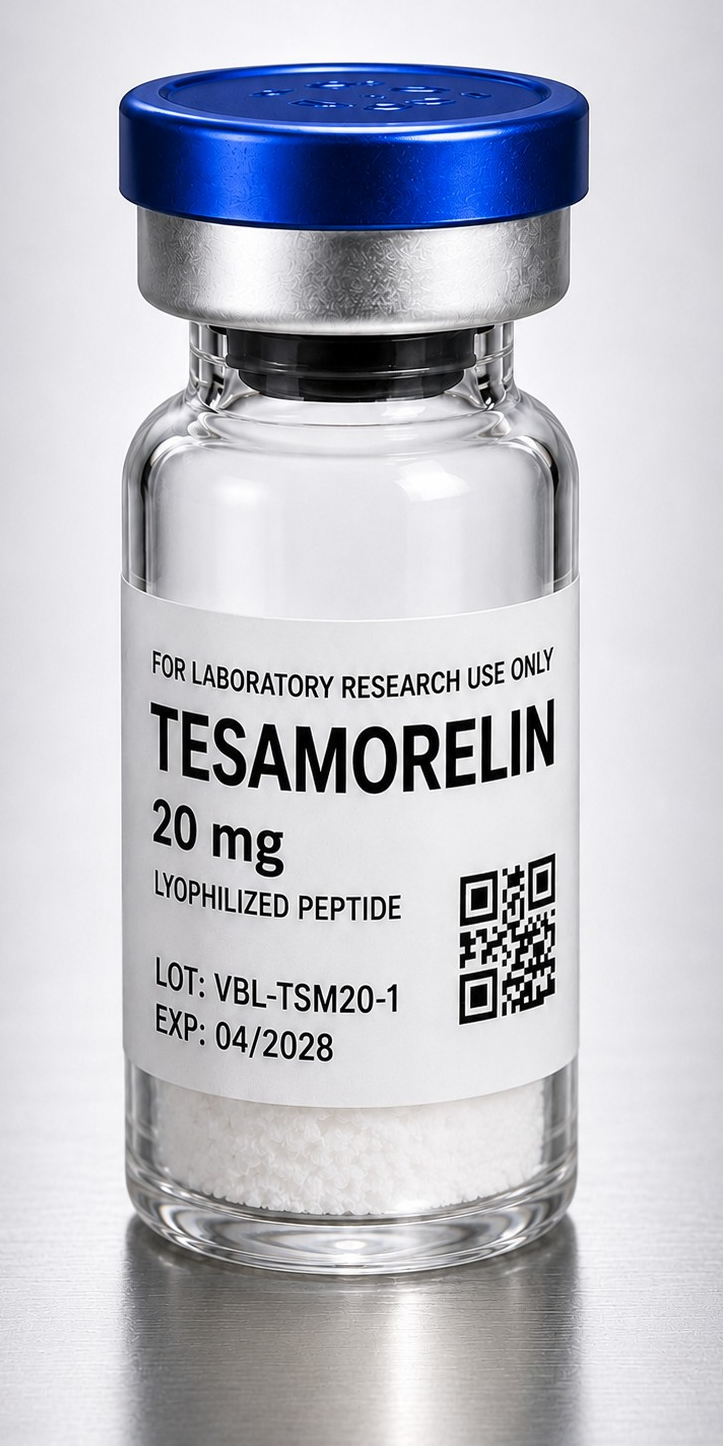
TESAMORELIN
REFERENCE STANDARD
Manufactured for Researchers Who Refuse to Compromise
Velora Biolabs manufactures, lyophilizes, packages, and fulfills research materials directly from our Wyoming laboratory.
Every production lot is assigned unique batch documentation, QR traceability, and lot-specific verification to support consistency and reproducibility.
Unlike suppliers relying on aging inventory and third-party fulfillment, Velora maintains direct oversight from production through shipment.
- Regular price
-
$39.00 - Sale price
-
$39.00
Couldn't load pickup availability


Scientific Background
Metabolic Regulation, Visceral Adiposity & Endocrine Signaling Studies
Category:
Endocrinology • Metabolic Research • Body Composition • GH Axis Modulation
What Researchers Study
Tesamorelin is a synthetic analog of Growth Hormone–Releasing Hormone (GHRH) consisting of the first 29 amino acids of native GHRH with a stabilizing trans-3-hexenoic acid modification.
Researchers study Tesamorelin because it:
-
Stimulates endogenous, pulsatile growth hormone (GH) release
-
Preserves physiologic GH rhythms
-
Elevates IGF-1 indirectly, rather than forcing supraphysiologic levels
-
Preferentially targets visceral adipose tissue
-
Minimizes proliferative risks associated with exogenous GH exposure
Tesamorelin is best understood as a GH-axis regulator, not a growth hormone itself.
Primary Signal Pathways Studied
-
GHRH receptor activation (anterior pituitary)
-
Pulsatile GH secretion
-
Hepatic IGF-1 signaling
-
Visceral adipose lipolysis
-
Insulin sensitivity modulation
-
Lipid metabolism and hepatic fat regulation
Why This Molecule Is Studied
Unlike direct GH administration—which creates continuous exposure and non-physiologic signaling—Tesamorelin restores upstream control of the GH axis.
This makes it uniquely valuable for studying:
-
Visceral fat biology
-
Metabolic syndrome
-
Lipid partitioning
-
Age-related GH decline
-
GH–IGF signaling without excessive tissue proliferation
Tesamorelin allows researchers to observe metabolic effects without overriding endocrine feedback loops.
Mechanistic Overview
Tesamorelin binds GHRH receptors in the anterior pituitary, stimulating natural GH pulses. These pulses then drive downstream IGF-1 production, lipid mobilization, and metabolic adaptations.
Key outcomes observed in research models include:
-
Preferential reduction of visceral (not subcutaneous) fat
-
Preservation of lean mass
-
Improved lipid profiles
-
Reduced hepatic steatosis
-
Improved insulin sensitivity
This endocrine selectivity is the defining feature of Tesamorelin.
Key Research Domains
1. Visceral Adiposity & Body Composition
Tesamorelin is most studied for its selective action on visceral fat depots, making it a reference compound in:
-
Central obesity models
-
HIV-associated lipodystrophy research
-
Age-related fat redistribution studies
Notably, reductions occur without significant loss of lean mass.
2. Metabolic Syndrome & Insulin Sensitivity
Research shows Tesamorelin improves:
-
Insulin sensitivity (HOMA-IR)
-
Triglyceride levels
-
Lipoprotein particle profiles
This positions Tesamorelin as a metabolic normalizer, not a stimulant.
3. Lipid & Cardiovascular Risk Research
Tesamorelin has demonstrated:
-
Reductions in triglycerides
-
Improvements in LDL particle size
-
Reduced atherogenic lipid fractions
Frequently studied in cardiometabolic risk models.
4. Hepatic Fat & NAFLD Research
Tesamorelin has shown meaningful reductions in:
-
Liver fat content
-
Markers of hepatic steatosis
This makes it relevant to fatty liver disease and metabolic liver dysfunction research.
Research Context & Comparisons
Tesamorelin vs GH
-
GH: Direct, continuous exposure
-
Tesamorelin: Pulsatile, endogenous stimulation
→ Lower proliferative risk, more physiologic signaling
Tesamorelin vs GHRPs (Ipamorelin, GHRP-6)
-
GHRPs act via ghrelin receptors
-
Tesamorelin acts via GHRH receptors
→ More metabolic and visceral-fat–specific effects
Product Specifications
-
Compound Name: Tesamorelin (TH9507)
-
CAS Number: 218949-48-5
-
Molecular Formula: C₂₂₁H₃₆₆N₇₂O₆₇S
-
Molecular Weight: 5,135.86 Da
-
Peptide Length: 29 amino acids
-
Peptide Class: GHRH analog
-
Purity: ≥98% (HPLC verified)
-
Form: Lyophilized powder
-
Appearance: White to off-white solid
-
Storage: ≤ –20 °C, desiccated, protected from light
Batch Documentation & Traceability
Each vial is shipped with a lot-specific QR code that provides secure access to batch documentation, including:
• Certificate of Analysis (COA)
• Identity verification report (HPLC / MS)
• Lot number, potency, and expiration
Documentation is locked to the specific batch shipped to ensure traceability, version control, and research reproducibility.
QR access is provided with the physical product and is not reused across lots.
Research Use Disclaimer
This product is supplied exclusively for laboratory research use.
Not for human or veterinary use.
Not intended for diagnostic, therapeutic, or consumptive applications.