

RETATRUTIDE | Reference Standard
- Regular price
-
$89.00 - Sale price
-
$89.00
Couldn't load pickup availability

Product Details
GLP-1 / GIP / Glucagon Receptor Signaling in Metabolic & Energy Homeostasis Research
Category: Metabolic Signaling • Energy Expenditure • Obesity & Glucose Regulation Research
What Researchers Study
Retatrutide (LY3437943) is a next-generation synthetic peptide designed to simultaneously activate:
-
GLP-1 receptors
-
GIP receptors
-
Glucagon receptors
This triple-agonist profile allows researchers to investigate coordinated regulation of appetite, insulin signaling, lipid mobilization, and energy expenditure within a single molecular framework.
Unlike GLP-1 mono-agonists or dual agonists, Retatrutide uniquely enables parallel study of anabolic and catabolic signaling pathways that are normally difficult to isolate experimentally.
Primary Signal Pathways Studied
-
GLP-1 receptor (GLP-1R): Satiety signaling, insulin secretion, gastric emptying
-
GIP receptor (GIPR): Nutrient partitioning, insulin sensitivity modulation
-
Glucagon receptor (GCGR): Lipolysis, hepatic glucose output, thermogenesis
-
Central–peripheral metabolic integration
-
Lean mass preservation during caloric deficit
Why This Molecule Is Studied
Researchers focus on Retatrutide because it allows:
-
Simultaneous interrogation of incretin + glucagon biology
-
Study of energy expenditure independent of caloric intake
-
Modeling of visceral fat reduction vs lean mass retention
-
Exploration of metabolic flexibility under chronic signaling
It represents a systems-level metabolic probe, rather than a single-axis appetite modulator.
Mechanistic Overview
Retatrutide binds three metabolically critical GPCRs with balanced affinity:
-
GLP-1R activation enhances insulin secretion and satiety signaling
-
GIPR modulation improves post-prandial glucose handling and lipid distribution
-
GCGR activation increases hepatic fat oxidation and basal energy expenditure
The combined signaling profile produces coordinated metabolic remodeling, making Retatrutide particularly valuable in longitudinal metabolic models.
Key Research Domains
1. Obesity & Body Composition Research
Used to study:
-
Visceral vs subcutaneous fat dynamics
-
Appetite-independent weight reduction
-
Lean mass preservation under caloric restriction
Frequently paired with:
-
DEXA or MRI body composition analysis
-
Automated food intake monitoring
-
Adipose tissue histology
2. Glucose Homeostasis & Insulin Sensitivity
Common endpoints include:
-
Fasting glucose and insulin levels
-
HOMA-IR and clamp studies
-
Pancreatic β-cell signaling dynamics
Allows differentiation between insulin secretion effects and peripheral glucose utilization.
3. Hepatic Lipid & NAFLD Models
Studied for:
-
Hepatic triglyceride reduction
-
Glycogen storage modulation
-
Lipid oxidation vs storage balance
Often combined with:
-
Liver histopathology
-
Triglyceride quantification
-
Gene expression analysis (PPARα, CPT-1, ACC)
4. Cardiometabolic & Energy Expenditure Research
Supports investigation of:
-
Resting energy expenditure
-
Thermogenic signaling
-
Autonomic metabolic regulation
Compatible with:
-
Indirect calorimetry
-
Telemetry-based cardiovascular monitoring
-
Vascular reactivity assays
Product Specifications
-
Compound Name: Retatrutide (LY3437943)
-
CAS Number: 2381089-83-2
-
Molecular Formula: C₂₂₁H₃₄₂N₄₆O₆₈
-
Molecular Weight: 4731.33 Da
-
Amino Acid Sequence:
Tyr-{Aib}-Gln-Gly-Thr-Phe-Thr-Ser-Asp-Tyr-Ser-Ile-{MeLeu}-Leu-Asp-Lys-{diacid-C20-gamma-Glu}-(AEEA)-Ala-Gln-{Leu-Me}-Ala-Phe-Ile-Glu-Tyr-Leu-Leu-Glu-Gly-Gly-Pro-Ser-Ser-Gly-Ala-Pro-Pro-Pro-Ser-NH2
- Peptide Class: GLP-1 / GIP / Glucagon triple-agonist
- Purity: ≥98% (HPLC verified)
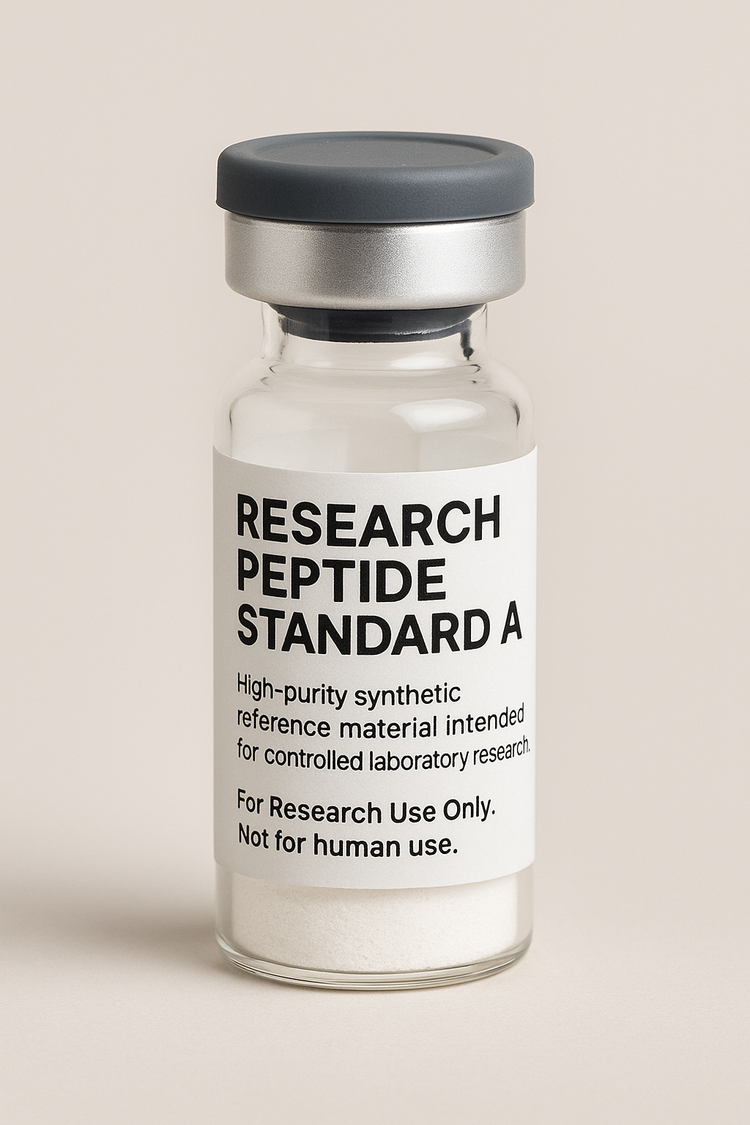
- Form: Lyophilized powder
-
Appearance: White to off-white solid
-
Storage: ≤ –20 °C, desiccated, protected from light
Batch Documentation & Traceability
Each vial is shipped with a lot-specific QR code that provides secure access to batch documentation, including:
• Certificate of Analysis (COA)
• Identity verification report (HPLC / MS)
• Lot number, potency, and expiration
Documentation is locked to the specific batch shipped to ensure traceability, version control, and research reproducibility.
QR access is provided with the physical product and is not reused across lots.
Research Use Disclaimer
This compound is supplied exclusively for laboratory research use.
Not for human or veterinary use.
Not for diagnostic, therapeutic, or consumptive applications.