
Metabolic Research
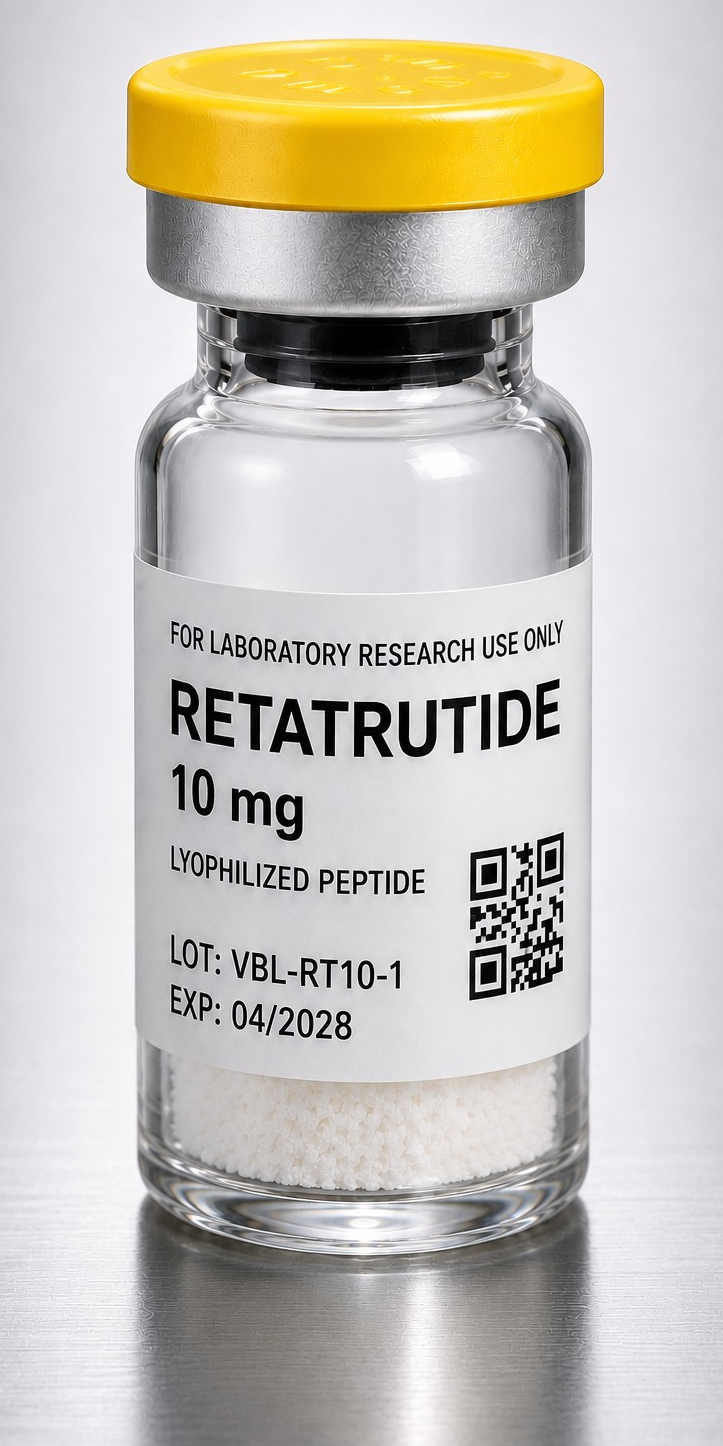
Lot Verification
Variant-specific documentation
Traceable Lots
VBL lot identification
Primary Literature
Peer-reviewed sources
Research Use Only
Laboratory research materials
Scientific Specifications
Reference characteristics for laboratory research materials.
CAS Number
2381089-83-2
Purity
≥98%
Molecular Formula
C221H342N46O68
Molecular Weight
4731.33 g/mol
Appearance
White powder
Solubility
≥30 mg/mL in water
Storage
-20°C (lyophilized); protect from light; avoid repeated freeze-thaw
Research Classification
Research Use Only (RUO). Not for human or veterinary use.
SCIENTIFIC OVERVIEW
Scientific background and research classification for this laboratory reference material.
Lyophilized Peptide
Laboratory Research
Receptor Pharmacology
Energy Homeostasis
Glucose Metabolism
Weight Management
Mechanism of Action
Molecular interaction profile describing how this research material engages receptor systems and influences downstream biological signaling pathways.
- Glucagon-Like Peptide-1 Receptor (GLP-1R)
- Glucose-Dependent Insulinotropic Polypeptide Receptor (GIPR)
- Glucagon Receptor (GCGR)
- GLP-1 Signaling
- GIP Signaling
- Glucagon Signaling
- Insulin Signaling
- Glucose Uptake
- Lipolysis
- Lipogenesis
- Fatty Acid Oxidation
- Endocrine System
- Hepatic System
- Gastrointestinal System
- Central Nervous System
- Metabolic System
Research Documentation
Laboratory documentation is presented when available for the selected product specification and current lot.
Batch Verified
Independent Batch Verification
Identity
Purity
Endotoxin
Fentanyl
Independent laboratory verification for this batch:
- Identity Confirmation
- HPLC Purity Analysis
- Net Peptide Content
- Endotoxin Testing
- Analytical Chromatogram
- Independent Laboratory Verification
Laboratory documentation for the current lot is being completed.
Scientific References
Peer-Reviewed Literature
Explore published literature, clinical investigations, and foundational scientific research.
View References →Laboratory Resources
Technical Guidance
Storage guidance, handling recommendations, analytical methods, and laboratory best practices.
Related Research
Companion Materials
Discover complementary research materials frequently studied alongside this compound.
Research Center
Scientific literature, laboratory resources, and related materials curated to support research involving this research material.
Scientific References
Peer-Reviewed Literature
Explore curated publications from peer-reviewed journals including clinical investigations, mechanistic studies, and foundational scientific literature.
Browse References →Scientific Dossier
Deeper Technical Treatment
Comprehensive scientific documentation including literature review, mechanism, pharmacology, and study data for this research material.
Laboratory Resources
Technical Guidance
Storage guidance, handling information, analytical standards, research policies, and laboratory support documentation.
Research Library
Curated peer-reviewed literature selected to provide scientific context for this research material.
Triple–Hormone-Receptor Agonist Retatrutide for Obesity — A Phase 2 Trial
Retatrutide (LY3437943) is a triple receptor agonist targeting the GLP-1, GIP, and glucagon receptors. In this randomized, placebo-controlled Phase II trial involving adults with obesity, once-weekly administration produced substantial dose-dependent reductions in body weight over 48 weeks while demonstrating an acceptable safety profile primarily characterized by gastrointestinal adverse events. The study established proof-of-concept for triple receptor agonism as a potential approach to metabolic disease research and laid the foundation for subsequent Phase III development.
Velora Research Insight
This publication represents the foundational clinical evidence supporting Retatrutide as an important laboratory reference material for metabolic research. Beyond demonstrating significant weight reduction in a clinical population, the study highlights the scientific importance of simultaneously activating GLP-1, GIP, and glucagon receptors. For laboratory investigators, this trial provides the primary clinical context for ongoing research into integrated metabolic signaling, energy homeostasis, nutrient utilization, and multi-receptor pharmacology.
Retatrutide, a GIP, GLP-1 and Glucagon Receptor Agonist, for People with Type 2 Diabetes: A Randomised, Double-Blind, Placebo and Active-Controlled, Parallel-Group, Phase 2 Trial
This randomized Phase II clinical trial evaluated Retatrutide (LY3437943), a triple agonist targeting the GLP-1, GIP, and glucagon receptors, in adults with type 2 diabetes inadequately controlled through diet and exercise. Multiple dose levels were compared with placebo and an active comparator. Retatrutide produced dose-dependent improvements in glycemic control, body weight, and several cardiometabolic measures while exhibiting a safety profile consistent with incretin-based therapies, primarily involving gastrointestinal adverse events. These findings demonstrated the therapeutic potential of simultaneous multi-receptor activation in metabolic disease research.
Velora Research Insight
While the Phase II obesity trial established Retatrutide's effects on body weight, this study demonstrated that triple receptor agonism also produces meaningful improvements in glycemic regulation and metabolic biomarkers. Together with the complementary obesity trial, these findings provide strong clinical evidence supporting triple receptor agonism as a promising research strategy for metabolic disease.
Triple hormone receptor agonist retatrutide for metabolic dysfunction-associated steatotic liver disease: a randomized phase 2a trial
This randomized, double-blind, placebo-controlled phase 2a substudy evaluated retatrutide in adults with metabolic dysfunction-associated steatotic liver disease and at least 10% liver fat. The prespecified primary objective was relative change from baseline in liver fat at 24 weeks, alongside additional metabolic measures (NCT04881760).
Velora Research Insight
Extends the retatrutide research literature from body-weight and glycemic endpoints into hepatic fat quantification, illustrating how triple-receptor agonism is investigated across interconnected metabolic organ systems — direct context for laboratory studies of hepatic lipid metabolism.
LY3437943, a novel triple glucagon, GIP, and GLP-1 receptor agonist for glycemic control and weight loss: From discovery to clinical proof of concept
The discovery and clinical proof-of-concept report for LY3437943 (retatrutide). Describes the peptide's engineering on a GIP backbone with C20 fatty-diacid conjugation, its in vitro receptor pharmacology across the glucagon, GIP, and GLP-1 receptors, preclinical characterization, and first-in-human data supporting further clinical evaluation.
Velora Research Insight
The primary mechanistic reference for retatrutide's balanced triple-receptor design — the source most often cited for its receptor-potency profile and extended half-life characteristics (Coskun et al., 2022).
LY3437943, a novel triple GIP, GLP-1, and glucagon receptor agonist in people with type 2 diabetes: a phase 1b, multicentre, double-blind, placebo-controlled, randomised, multiple-ascending dose trial
A phase 1b, multicentre, double-blind, placebo-controlled, randomised clinical trial of LY3437943 in people with type 2 diabetes, characterizing safety, tolerability, pharmacokinetics, and pharmacodynamics over 12 weeks (NCT04143802).
Velora Research Insight
Establishes the early clinical pharmacokinetic foundation for retatrutide — including the approximately six-day circulating half-life reported in published studies — that underpins the later phase 2 investigations in the research literature.