

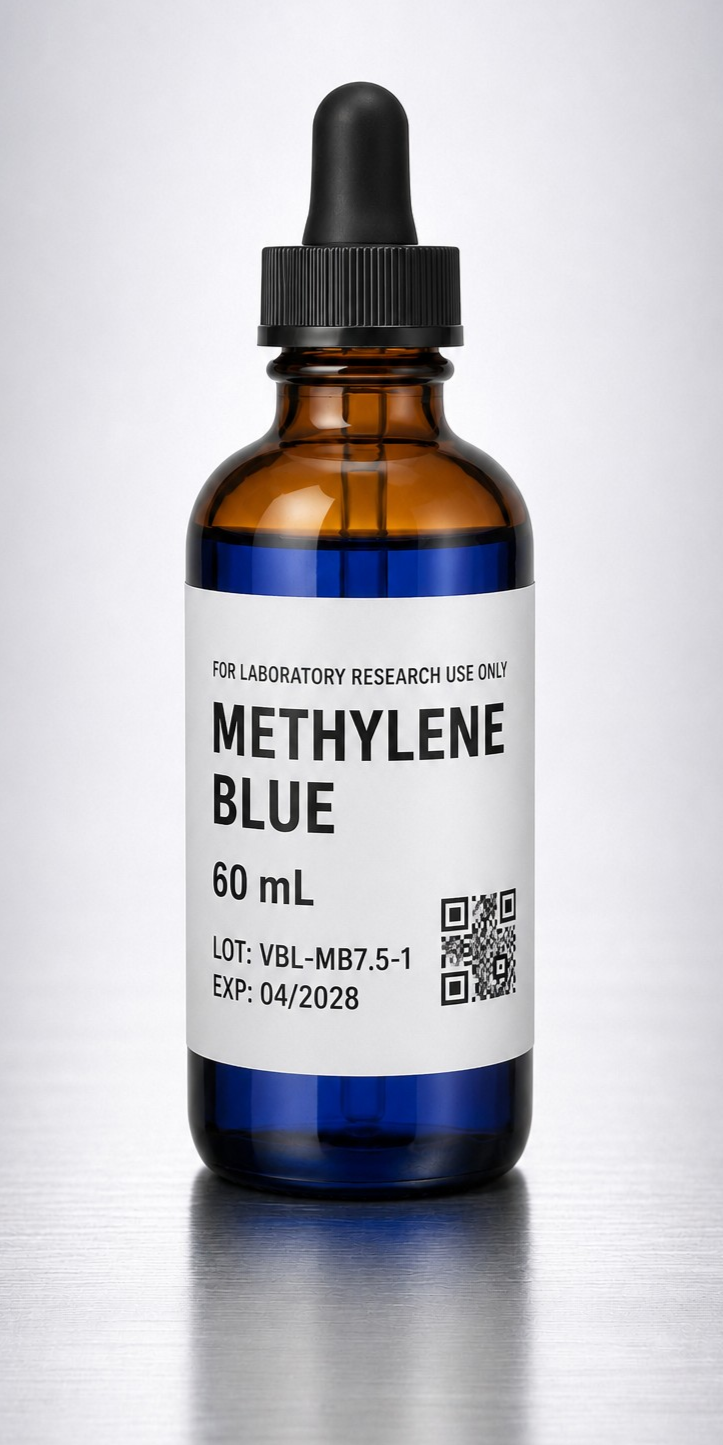
METHYLENE BLUE
REFERENCE STANDARD
Manufactured for Researchers Who Refuse to Compromise
Velora Biolabs manufactures, lyophilizes, packages, and fulfills research materials directly from our Wyoming laboratory.
Every production lot is assigned unique batch documentation, QR traceability, and lot-specific verification to support consistency and reproducibility.
Unlike suppliers relying on aging inventory and third-party fulfillment, Velora maintains direct oversight from production through shipment.
- Regular price
-
$29.00 - Sale price
-
$29.00
Couldn't load pickup availability

Scientific Background
Redox-Active Phenothiazine for Mitochondrial, Bioenergetic & Cellular Redox Research
Category:
Mitochondrial & Bioenergetic Research • Cellular Redox Biology • Neuroenergetic Signaling • Small-Molecule Research Compounds
What Researchers Study
Methylene Blue (MB) is a redox-active phenothiazine compound with a long history in biochemical and cellular research. In modern laboratory settings, researchers study methylene blue primarily for its ability to modulate mitochondrial electron transport, support cellular redox cycling, and influence energy metabolism under conditions of oxidative or metabolic stress.
Unlike peptides that act through receptor signaling, methylene blue functions as a redox mediator, participating directly in electron transfer processes within cells.
Primary Signal Pathways Studied
Research involving methylene blue focuses on its interaction with:
-
Mitochondrial electron transport chain (ETC), particularly complex I and III electron flow
-
Cellular redox cycling, alternating between oxidized (MB) and reduced (leucomethylene blue) states
-
Reactive oxygen species (ROS) modulation, influencing oxidative stress balance
-
NAD⁺/NADH and FAD/FADH₂ systems, supporting cellular energy metabolism
-
Neuroenergetic signaling pathways, linked to neuronal metabolic demand
Methylene blue is often studied as a mitochondrial bypass or electron shuttle, especially in models of impaired oxidative phosphorylation.
Why This Compound Is Studied
Mitochondrial dysfunction and redox imbalance are central features of aging, neurodegeneration, metabolic disease, and cellular stress models. Many compounds influence mitochondria indirectly, making mechanistic attribution difficult.
Methylene blue is studied because it allows researchers to:
-
Examine direct modulation of mitochondrial electron flow
-
Investigate how redox cycling affects cellular energy efficiency
-
Explore oxidative stress resilience in neurons and metabolically active cells
-
Study mitochondrial support mechanisms without receptor-based signaling
This positions methylene blue as a core research tool in mitochondrial biology and cellular energetics.
Research Areas of Interest
Mitochondrial & Bioenergetic Research
Methylene blue is widely studied in models of mitochondrial dysfunction, impaired ATP production, and oxidative phosphorylation stress.
Redox & Oxidative Stress Biology
Research explores how redox-active compounds influence ROS balance, antioxidant systems, and cellular survival thresholds.
Neuroenergetic & Cognitive Models
Because neurons are highly energy-dependent, methylene blue is examined in neuroenergetic and synaptic metabolism research.
Cellular Stress & Aging Models
Methylene blue is used to investigate how redox modulation impacts aging-associated cellular decline and metabolic stress resilience.
Selected Scientific References
-
Wen et al., Journal of Neuroscience — Methylene blue and mitochondrial respiration
-
Atamna et al., FASEB Journal — Redox cycling and mitochondrial support
-
Rojas et al., Neurobiology of Aging — Mitochondrial dysfunction and redox modulation
-
Schirmer et al., Antioxidants & Redox Signaling — Phenothiazines and cellular redox biology
(References provided for educational context and literature navigation.)
Product Specifications
-
Compound Name: Methylene Blue (Methylthioninium Chloride)
-
CAS Number: 7220-79-3
-
Molecular Formula: C₁₆H₁₈ClN₃S · 3H₂O
-
Molecular Weight: 319.85 Da
-
Purity: ≥99% (analytical grade)
-
Form: Crystalline powder
-
Appearance: Deep blue solid
-
Storage: Room temperature, dry, protected from light
Batch Documentation & Traceability
Each vial is shipped with a lot-specific QR code that provides secure access to batch documentation, including:
• Certificate of Analysis (COA)
• Identity verification report (HPLC / MS)
• Lot number, potency, and expiration
Documentation is locked to the specific batch shipped to ensure traceability, version control, and research reproducibility.
QR access is provided with the physical product and is not reused across lots.
Research Use Disclaimer
This product is supplied strictly for laboratory research and in-vitro or preclinical investigation.
Not for human or veterinary use.
Not for diagnostic, therapeutic, cosmetic, or consumptive applications.