
Wolverine Peptide Blend | Tissue Repair Research
REFERENCE STANDARD
Manufactured for Researchers Who Refuse to Compromise
Velora Biolabs manufactures, lyophilizes, packages, and fulfills research materials directly from our Wyoming laboratory.
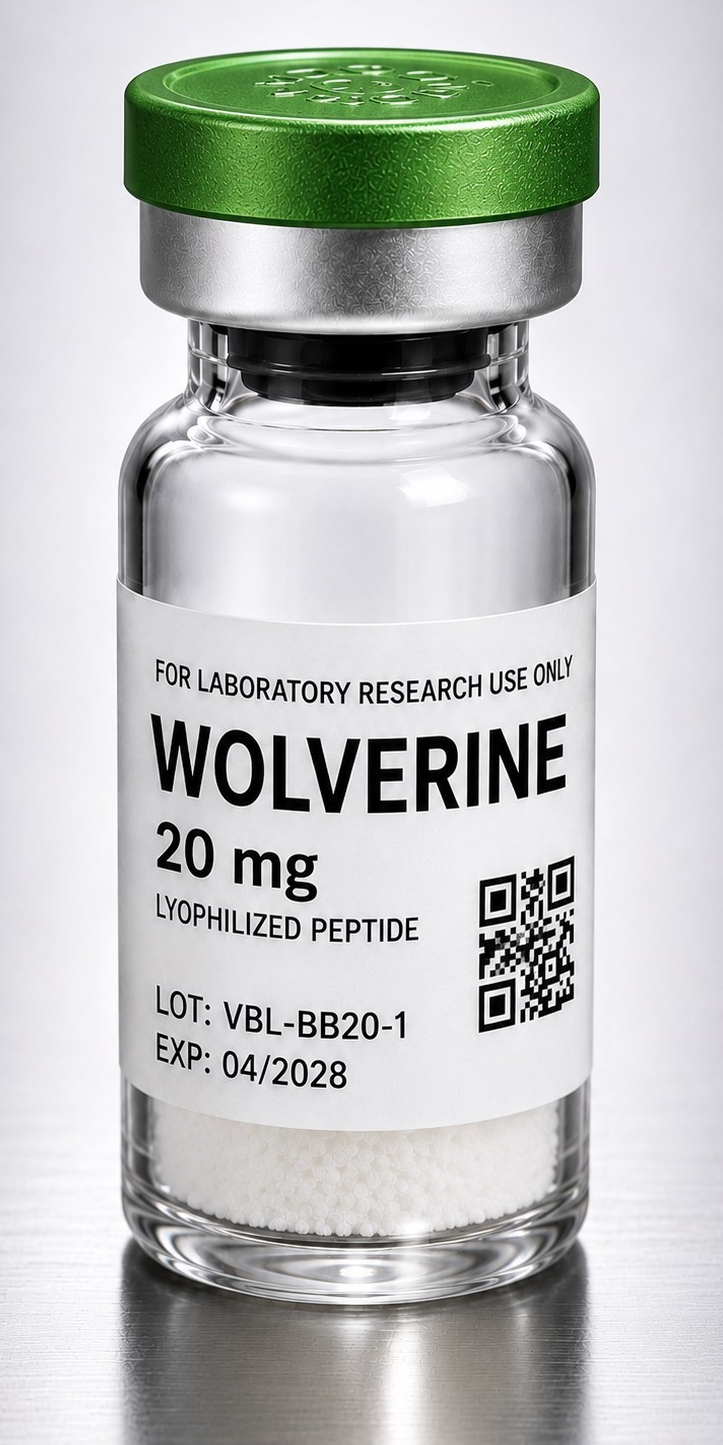
Every production lot is assigned unique batch documentation, QR traceability, and lot-specific verification to support consistency and reproducibility.
Unlike suppliers relying on aging inventory and third-party fulfillment, Velora maintains direct oversight from production through shipment.
- Regular price
-
$119.00 - Sale price
-
$119.00
Couldn't load pickup availability

Scientific Background
Tissue Repair, Angiogenesis & Coordinated Regenerative Signaling Research
Category:
Healing Research • Tissue Biology • Angiogenesis • Cytoprotective Signaling • Extracellular Matrix Research
What Researchers Study
Wolverine is Velora Biolabs' dual-peptide research formulation containing BPC-157 (10 mg) and TB-500 (10 mg), developed for laboratory investigation of tissue repair, angiogenesis, connective tissue biology, and regenerative signaling.
Researchers study this combination because the two peptides influence complementary aspects of tissue repair:
- Cellular migration
- Angiogenesis
- Extracellular matrix remodeling
- Tendon and ligament biology
- Muscle regeneration
- Inflammation modulation
Rather than acting through a single receptor system, Wolverine is investigated as a coordinated BPC-157 and TB-500 research formulation for understanding how multiple regenerative pathways interact during the early and intermediate phases of tissue repair.
Primary Biological Pathways Studied
Current research focuses on:
- VEGF-mediated angiogenesis
- Nitric oxide signaling
- Endothelial cell migration
- Fibroblast migration
- Fibroblast proliferation
- Collagen organization
- Cytoskeletal remodeling
- Actin polymerization
- Focal adhesion signaling
- Extracellular matrix remodeling
- Cytokine modulation
- Tendon and ligament repair biology
Why Researchers Study Wolverine
BPC-157 and TB-500 exhibit different but complementary biological properties.
BPC-157 Research
Investigated for:
- Cytoprotective signaling
- Angiogenesis
- Gastrointestinal tissue biology
- Tendon and ligament regeneration
- Nitric oxide regulation
- Cellular migration
TB-500 Research
Investigated for:
- Cell migration
- Actin regulation
- Cytoskeletal organization
- Wound repair
- Tissue remodeling
- Broad regenerative signaling
When studied together, investigators evaluate whether simultaneous activation of these pathways produces different regenerative characteristics than either peptide alone.
Mechanistic Overview
Although often grouped together in regenerative research, the two peptides influence different biological systems.
BPC-157
Research suggests activity involving:
- VEGF signaling
- Nitric oxide pathways
- Endothelial cell biology
- Fibroblast activity
- Cytoprotection
TB-500
Derived from the active region of Thymosin Beta-4, TB-500 research centers on:
- Actin binding
- Cellular migration
- Cytoskeletal remodeling
- Tissue remodeling
- Angiogenic support
Together, BPC-157 and TB-500 provide researchers with a complementary model for investigating angiogenesis, cellular migration, extracellular matrix remodeling, and coordinated regenerative signaling across multiple tissue types.
Key Research Findings
BPC-157
Laboratory investigations have explored BPC-157 in models of tendon, ligament, gastrointestinal, and soft tissue biology, with particular focus on:
- Angiogenesis
- Fibroblast migration
- Nitric oxide signaling
- Cytoprotective mechanisms
- Connective tissue remodeling
Reference:
https://pubmed.ncbi.nlm.nih.gov/?term=BPC-157
TB-500
Research involving TB-500 has examined its influence on:
- Actin dynamics
- Cellular migration
- Cytoskeletal remodeling
- Extracellular matrix organization
- Angiogenic support during tissue repair
Reference:
https://pubmed.ncbi.nlm.nih.gov/?term=Thymosin+Beta+4
Combination Research
Current laboratory interest in Wolverine centers on evaluating how simultaneous exposure to BPC-157 and TB-500 influences coordinated regenerative signaling, connective tissue remodeling, angiogenesis, and cellular migration when compared with either peptide studied independently.
Research Context & Considerations
-
Researchers generally recognize that tissue repair occurs in distinct biological phases.
Study design frequently evaluates:
- Timing of administration
- Local versus systemic exposure
- Duration of signaling
- Cell migration
- Matrix remodeling
- Angiogenic response
The combination is commonly investigated in tendon, ligament, skeletal muscle, connective tissue, and soft tissue research models.
Because tissue repair is a dynamic biological process, researchers frequently investigate Wolverine across multiple experimental models to evaluate temporal changes in angiogenesis, extracellular matrix remodeling, inflammatory signaling, and functional tissue recovery.
Product Specifications
-
Compound Name: Wolverine
Composition:
- BPC-157 — 10 mg
- TB-500 — 10 mg
Total Content: 20 mg
Peptide Class:
Synthetic regenerative research peptides
Purity:
≥98% (HPLC Verified)
Form:
Lyophilized powder
Appearance:
White to off-white solid
Storage:
≤ –20 °C, desiccated, protected from light
Batch Documentation & Traceability
Each vial is supplied with a lot-specific QR code providing secure access to batch documentation, including:
- Certificate of Analysis (COA)
- Identity Verification Report (HPLC / MS)
- Lot Number
- Potency
- Expiration Date
Documentation is permanently associated with the manufactured batch to support traceability, version control, and research reproducibility.
QR access is unique to each production lot and is never reused across batches.
Research Use Disclaimer
This material is supplied exclusively for laboratory research purposes. It is not intended for human or veterinary use and must not be used for diagnostic, therapeutic, clinical, or consumptive applications. Handling should be performed only by qualified laboratory personnel using appropriate research practices.
Related Research Areas
Researchers investigating Wolverine frequently explore related fields including:
- Tendon and Ligament Biology
- Skeletal Muscle Repair
- Angiogenesis Research
- Extracellular Matrix Remodeling
- Connective Tissue Biology
- Inflammation and Resolution Biology
- Exercise Recovery Models
- Regenerative Signaling Networks