

ARA-290 Peptide | Innate Repair Research
REFERENCE STANDARD
Manufactured for Researchers Who Refuse to Compromise
Velora Biolabs manufactures, lyophilizes, packages, and fulfills research materials directly from our Wyoming laboratory.
Every production lot is assigned unique batch documentation, QR traceability, and lot-specific verification to support consistency and reproducibility.
Unlike suppliers relying on aging inventory and third-party fulfillment, Velora maintains direct oversight from production through shipment.
- Regular price
-
$89.00 - Sale price
-
$89.00
Couldn't load pickup availability

Scientific Background
Investigational Peptide for Innate Repair Receptor & Cytoprotective Signaling Research
Category:
Innate Repair Research • Cytoprotective Signaling • Tissue Biology • Inflammation Research
What Researchers Study
ARA-290 is an investigational peptide derived from the three-dimensional structure of erythropoietin (EPO) that is studied for its interaction with the innate repair receptor (IRR) in laboratory and preclinical research models.
Unlike erythropoietin's classical role in erythropoiesis, ARA-290 is investigated for biological processes associated with tissue protection, cellular stress responses, inflammatory signaling, and tissue repair without activation of the classical erythropoietic pathway.
Researchers study ARA-290 to better understand how innate repair signaling contributes to cellular resilience, tissue recovery, and inflammatory regulation across multiple organ systems.
Primary Biological Pathways Studied
Research involving ARA-290 commonly investigates:
- Innate repair receptor (IRR) signaling
- Cytoprotective signaling pathways
- Inflammatory cytokine regulation
- Tissue repair biology
- Cellular stress-response mechanisms
- Macrophage and immune cell communication
- Peripheral nerve biology
- Endothelial signaling
- Tissue resilience and recovery
Rather than functioning as a traditional growth factor, ARA-290 is studied for its ability to investigate endogenous tissue-protective signaling mechanisms.
Why This Peptide Is Studied
Tissue injury and inflammation activate complex repair pathways that extend beyond immune regulation alone.
Researchers investigate ARA-290 because it provides a laboratory tool for studying innate repair signaling independently of erythropoietic activity, allowing investigation of cytoprotective biology, inflammatory regulation, and tissue resilience in controlled experimental models.
Current research explores how innate repair receptor activation may influence:
- Cellular recovery following stress
- Tissue remodeling
- Immune communication
- Inflammatory signaling
- Endogenous repair mechanisms
Research Areas of Interest
Innate Repair Biology
Research examines receptor-mediated signaling involved in endogenous tissue protection and cellular recovery.
Cytoprotective Signaling
Studies investigate cellular responses to physiological stress, inflammatory stimuli, and tissue injury.
Inflammation Research
Current laboratory models explore communication between inflammatory mediators and endogenous repair pathways.
Tissue Biology
Research investigates mechanisms involved in tissue resilience, recovery, and coordinated repair signaling.
Selected Scientific References
- Brines M., Cerami A. — Innate Repair Receptor biology and tissue protection
- Brines et al. — ARA-290 and tissue-protective peptide research
- Leist et al. — Cytoprotective signaling in experimental models
- Nature Reviews Immunology — Inflammation and endogenous tissue repair
(References provided for educational context and literature navigation.)
Product Specifications
Compound Name: ARA-290 (Cibinetide)
CAS Number: 1208243-50-8
Molecular Formula: C₅₁H₈₄N₁₆O₂₁
Amino Acid Sequence: Pyr-Glu-Gln-Leu-Glu-Arg-Ala-Leu-Asn-Ser-Ser
Molecular Weight: 1257.3 g/mol
Purity: ≥98% (HPLC verified)
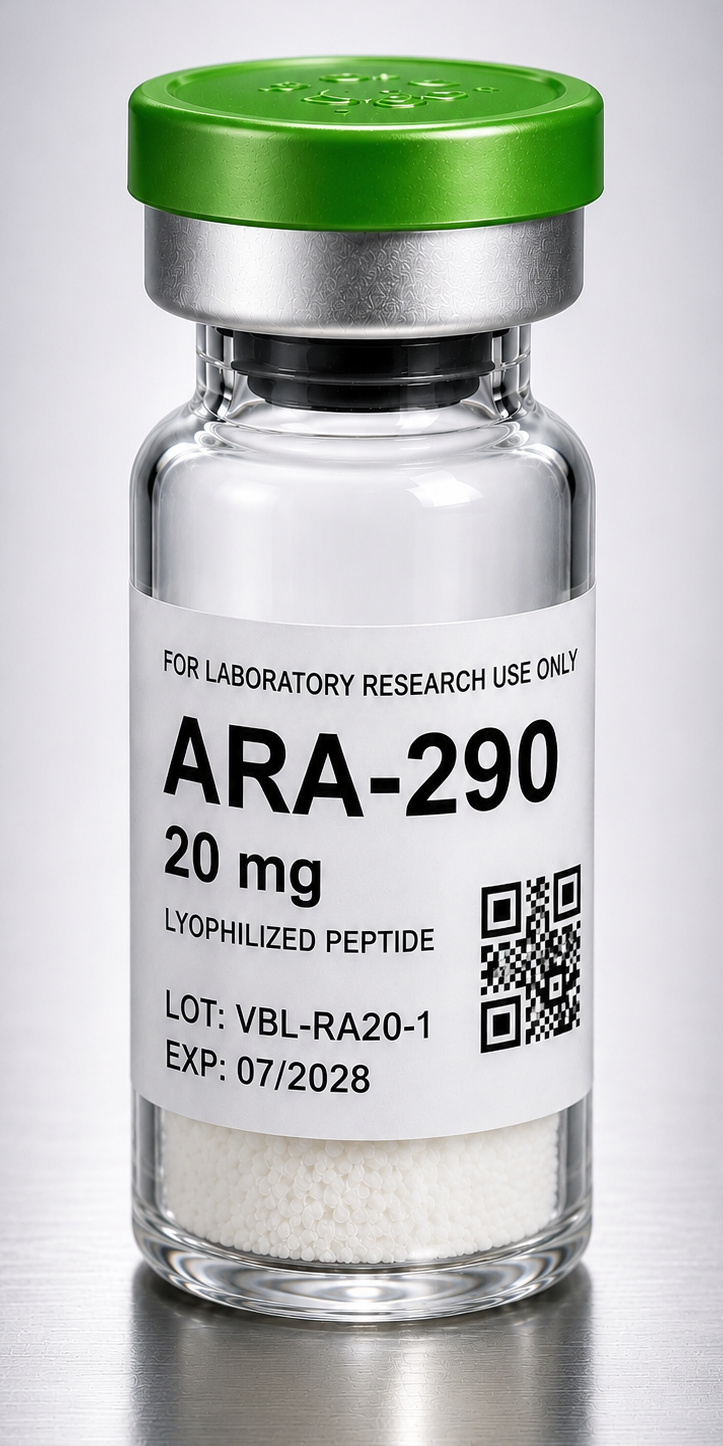
Form: Lyophilized powder
Appearance: White to off-white lyophilized solid
Storage: ≤ –20 °C, desiccated, protected from light