

Oxytocin Peptide | Synthetic Research Standard
REFERENCE STANDARD
Manufactured for Researchers Who Refuse to Compromise
Velora Biolabs manufactures, lyophilizes, packages, and fulfills research materials directly from our Wyoming laboratory.
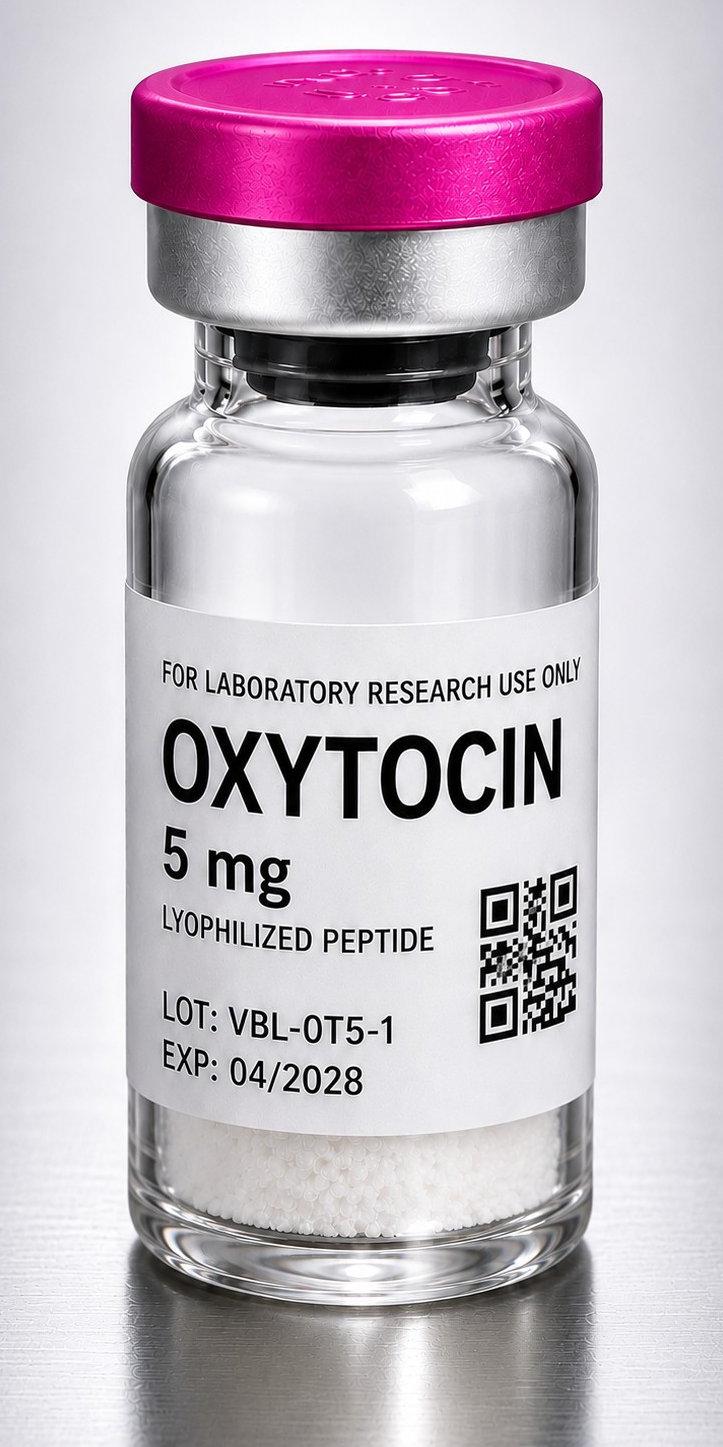
Every production lot is assigned unique batch documentation, QR traceability, and lot-specific verification to support consistency and reproducibility.
Unlike suppliers relying on aging inventory and third-party fulfillment, Velora maintains direct oversight from production through shipment.
- Regular price
-
$49.00 - Sale price
-
$49.00
Couldn't load pickup availability

Scientific Background
Social Bonding, Neuroendocrine Regulation & Stress-Modulation Signaling Research
Category:
Neuroendocrine Signaling • Behavioral & Social Neuroscience • Stress & Autonomic Regulation • Reproductive & Lactation Pathway Research
What Researchers Study
Oxytocin is a nonapeptide hormone and neuropeptide synthesized primarily in the paraventricular and supraoptic nuclei of the hypothalamus and released both peripherally via the posterior pituitary and centrally within the brain.
Researchers study oxytocin for its dual endocrine and neuromodulatory roles, particularly its influence on social behavior, emotional regulation, stress response, reproductive physiology, and autonomic balance.
Unlike many hormones that act through a single system, oxytocin operates as a context-dependent signaling molecule, exerting different effects based on receptor density, neural circuitry, and environmental cues.
Primary Signal Pathways Studied
Oxytocin research focuses on:
-
Oxytocin receptor (OXTR) GPCR signaling
-
Hypothalamic–pituitary–adrenal (HPA) axis modulation
-
Amygdala and limbic system activity regulation
-
Autonomic nervous system balance (parasympathetic tone)
-
Calcium-mediated intracellular signaling cascades
Why This Molecule Is Studied
Oxytocin is studied because it functions as a biological integrator of social, emotional, and physiological states.
Research interest has expanded significantly due to findings that oxytocin signaling is involved in:
-
Social bonding and affiliative behavior
-
Stress attenuation and cortisol suppression
-
Emotional recognition and trust processing
-
Maternal behavior and lactation reflexes
-
Sexual behavior and pair bonding
Altered oxytocin signaling has been observed in multiple neuropsychiatric and neurodevelopmental research models, making it a focal point for systems-level behavioral biology.
Key Research Areas
Social Behavior & Affiliation
Oxytocin modulates neural circuits involved in:
-
Social recognition
-
Pair bonding
-
Group cohesion and trust-related behaviors
Stress & Anxiety Regulation
Oxytocin interacts with the HPA axis to:
-
Reduce stress-induced cortisol release
-
Buffer autonomic stress responses
-
Promote parasympathetic nervous system activity
Neurodevelopmental Research
Oxytocin signaling is studied in models of:
-
Social communication deficits
-
Sensory integration
-
Behavioral flexibility
Reproductive & Lactation Pathways
Peripherally, oxytocin regulates:
-
Uterine smooth muscle contraction
-
Milk ejection reflex
-
Reproductive timing coordination
Mechanistic Overview (Simplified)
At the cellular level, oxytocin binds to the oxytocin receptor (OXTR), a G-protein–coupled receptor that activates:
-
Phospholipase C (PLC)
-
Inositol triphosphate (IP₃)
-
Intracellular calcium release
This cascade produces rapid effects in smooth muscle and slower neuromodulatory effects in central nervous system circuits.
Research Context Highlights
-
Oxytocin signaling is highly state-dependent
-
Central vs peripheral effects differ substantially
-
Receptor distribution varies across brain regions
-
Effects are modulated by sex hormones and developmental stage
These properties make oxytocin especially valuable for precision neurobiology research.
Product Specifications
-
Compound Name: Oxytocin
-
CAS Number: 50-56-6
-
Molecular Formula: C₄₃H₆₆N₁₂O₁₂S₂
-
Molecular Weight: 1007.19 Da
-
Amino Acid Sequence: Cys-Tyr-Ile-Gln-Asn-Cys-Pro-Leu-Gly-NH₂
-
Purity: ≥98% (HPLC verified)
-
Form: Lyophilized powder
-
Appearance: White to off-white solid
-
Storage: ≤ –20 °C, desiccated, protected from light
Batch Documentation & Traceability
Each vial is shipped with a lot-specific QR code that provides secure access to batch documentation, including:
• Certificate of Analysis (COA)
• Identity verification report (HPLC / MS)
• Lot number, potency, and expiration
Documentation is locked to the specific batch shipped to ensure traceability, version control, and research reproducibility.
QR access is provided with the physical product and is not reused across lots.
Research Use Disclaimer
This compound is supplied exclusively for laboratory research use.
Not for human or veterinary use.
Not for diagnostic, therapeutic, or consumptive applications.