

NAD+
REFERENCE STANDARD
Manufactured for Researchers Who Refuse to Compromise
Velora Biolabs manufactures, lyophilizes, packages, and fulfills research materials directly from our Wyoming laboratory.
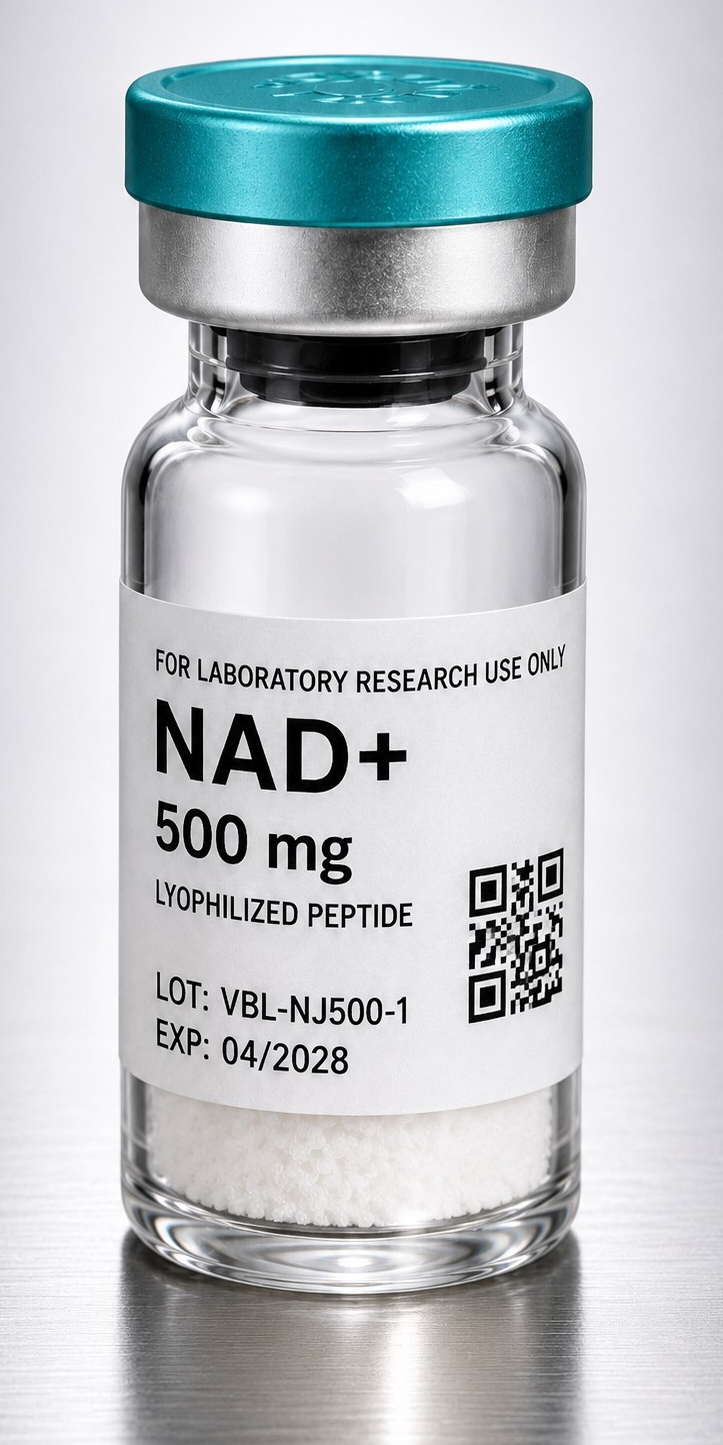
Every production lot is assigned unique batch documentation, QR traceability, and lot-specific verification to support consistency and reproducibility.
Unlike suppliers relying on aging inventory and third-party fulfillment, Velora maintains direct oversight from production through shipment.
- Regular price
-
$59.00 - Sale price
-
$59.00
Couldn't load pickup availability

Scientific Background
Central Redox Coenzyme for Cellular Energy, DNA Repair & Longevity Pathway Research
Category:
Longevity & Systemic Optimization • Mitochondrial & Redox Signaling • DNA Repair & Stress Response • Metabolic Pathway Research
What Researchers Study
NAD⁺ (β-Nicotinamide Adenine Dinucleotide) is an essential intracellular coenzyme present in all living cells. It plays a foundational role in cellular energy metabolism, redox balance, and enzyme-mediated signaling pathways critical to cellular survival and adaptation.
Researchers study NAD⁺ as a rate-limiting molecule in multiple biological systems, particularly those governing aging, metabolic efficiency, mitochondrial integrity, and genomic maintenance.
Primary Signal Pathways Studied
NAD⁺ research focuses on its involvement in:
-
Redox reactions (NAD⁺ / NADH cycling) supporting ATP production
-
Sirtuin-dependent signaling pathways (SIRT1–SIRT7)
-
PARP-mediated DNA damage response and repair
-
CD38 / CD157 NAD⁺ consumption and immune signaling
-
Mitochondrial oxidative metabolism and stress resilience
The intracellular NAD⁺ : NADH ratio is considered a key indicator of cellular metabolic health.
Why This Molecule Is Studied
A consistent finding across aging, metabolic disease, and neurodegeneration research is a progressive decline in intracellular NAD⁺ levels. This reduction is associated with:
-
Impaired mitochondrial function
-
Reduced DNA repair capacity
-
Altered gene expression and epigenetic drift
-
Decreased cellular stress tolerance
NAD⁺ is studied because it sits at the intersection of energy production, genomic stability, and longevity signaling, making it a central molecule in systems-level biology.
Key Research Areas
Mitochondrial Function & Bioenergetics
NAD⁺ is required for oxidative phosphorylation and electron transport chain activity via NADH production.
DNA Repair & Genomic Stability
PARP enzymes consume NAD⁺ during DNA repair, linking NAD⁺ availability to genomic integrity.
Longevity & Stress Response Pathways
Sirtuins rely on NAD⁺ to regulate transcription, mitochondrial biogenesis, antioxidant defenses, and stress-response genes.
Neuro-Metabolic Research
High-energy tissues such as the brain are particularly sensitive to NAD⁺ availability, making it a focal point in neurodegeneration studies.
Selected Research Context (Educational)
-
NAD⁺ decline is a conserved feature of aging across species
-
Sirtuin activity is directly proportional to NAD⁺ availability
-
Excessive PARP activation can deplete NAD⁺ pools under stress
-
CD38 expression increases with age, accelerating NAD⁺ breakdown
(References provided for literature navigation and educational context.)
Product Specifications
-
Compound Name: β-Nicotinamide Adenine Dinucleotide (Disodium Salt)
-
CAS Number: 53-84-9
-
Molecular Formula: C₂₁H₂₇N₇O₁₄P₂
-
Molecular Weight: 663.43 Da
-
Purity: ≥98% (HPLC verified)
-
Form: Lyophilized powder
-
Appearance: White to off-white solid
-
Solubility: Water soluble
-
Storage: ≤ –20 °C, desiccated, protected from light
Batch Documentation & Traceability
Each vial is shipped with a lot-specific QR code that provides secure access to batch documentation, including:
• Certificate of Analysis (COA)
• Identity verification report (HPLC / MS)
• Lot number, potency, and expiration
Documentation is locked to the specific batch shipped to ensure traceability, version control, and research reproducibility.
QR access is provided with the physical product and is not reused across lots.
Research Use Disclaimer
This compound is supplied exclusively for laboratory research use.
Not for human or veterinary use.
Not for diagnostic, therapeutic, cosmetic, or consumptive applications.