

KISSPEPTIN-10
REFERENCE STANDARD
Manufactured for Researchers Who Refuse to Compromise
Velora Biolabs manufactures, lyophilizes, packages, and fulfills research materials directly from our Wyoming laboratory.
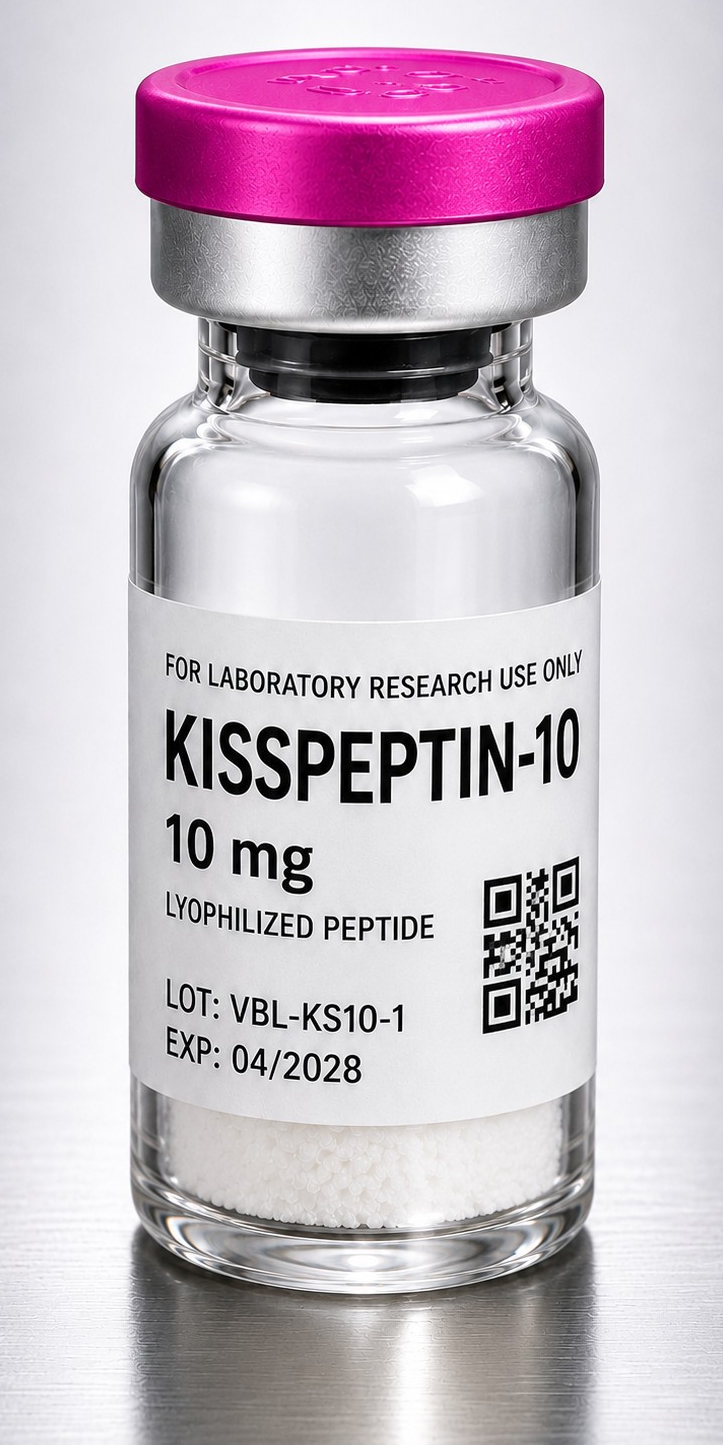
Every production lot is assigned unique batch documentation, QR traceability, and lot-specific verification to support consistency and reproducibility.
Unlike suppliers relying on aging inventory and third-party fulfillment, Velora maintains direct oversight from production through shipment.
- Regular price
-
$39.00 - Sale price
-
$39.00
Couldn't load pickup availability

Scientific Background
Neuropeptide Regulator of the Hypothalamic-Pituitary-Gonadal (HPG) Axis
Category:
Reproductive Endocrinology • Neuroendocrine Signaling • Hypothalamic-Pituitary Axis Research
What Researchers Study
Kisspeptin-10 (also known as Metastin 45–54) is a decapeptide fragment derived from the endogenous KISS1 gene product. It is the natural ligand for the KISS1 receptor (KISS1R / GPR54) and is widely recognized as a central upstream regulator of reproductive neuroendocrine signaling.
Researchers study Kisspeptin-10 for its role in gonadotropin-releasing hormone (GnRH) neuron activation, integration of hormonal feedback, and coordination of reproductive axis signaling within the central nervous system.
Primary Signal Pathways Studied
Research involving Kisspeptin-10 focuses on its role within:
-
KISS1R (GPR54) receptor signaling, a G-protein–coupled receptor pathway
-
GnRH neuronal activation, particularly in hypothalamic nuclei
-
Luteinizing hormone (LH) and follicle-stimulating hormone (FSH) regulation, downstream of GnRH
-
Sex-steroid feedback integration, including estrogen-mediated modulation
-
Neuroendocrine pulse-generation mechanisms, coordinating reproductive signaling
Kisspeptin-10 is studied as a gatekeeper peptide, linking environmental, metabolic, and hormonal cues to reproductive axis activation.
Why This Peptide Is Studied
The reproductive endocrine system depends on tightly regulated signaling between the brain and gonads. Disruption at the hypothalamic level can profoundly alter downstream hormonal function.
Kisspeptin-10 is studied because it allows researchers to:
-
Examine direct control of GnRH neuron activity
-
Investigate mechanisms governing puberty onset and reproductive maturation
-
Explore feedback regulation within the HPG axis
-
Study how metabolic or environmental stressors influence reproductive signaling
This makes Kisspeptin-10 a foundational research tool in neuroendocrinology and reproductive physiology.
Research Areas of Interest
Reproductive Endocrinology
Kisspeptin-10 is central to studies examining GnRH release, gonadotropin signaling, and reproductive hormone coordination.
Puberty & Developmental Biology
Research explores how kisspeptin signaling governs the timing and initiation of reproductive maturation.
Metabolic-Reproductive Integration
Because reproductive signaling is sensitive to energy balance, Kisspeptin-10 is studied in models linking metabolism, nutrition, and fertility.
Neuroendocrine Circuitry
Kisspeptin-10 is used to map hypothalamic circuits involved in pulse generation and hormonal rhythm regulation.
Selected Scientific References
-
Kotani et al., Journal of Biological Chemistry — Identification of kisspeptins as ligands for GPR54
-
Gottsch et al., Endocrinology — Kisspeptin control of GnRH secretion
-
Seminara et al., New England Journal of Medicine — GPR54 as a regulator of puberty
-
Plant, Frontiers in Neuroendocrinology — Neuroendocrine control of reproductive axis
(References provided for educational context and literature navigation.)
Product Specifications
-
Compound Name: Kisspeptin-10
-
CAS Number: 374675-21-5
-
Molecular Formula: C₆₃H₈₃N₁₇O₁₄
-
Amino Acid Sequence: Tyr-Asn-Trp-Asn-Ser-Phe-Gly-Leu-Arg-Phe-NH₂
-
Molecular Weight: 1,302.46 Da
-
Purity: ≥98% (HPLC verified)
-
Form: Lyophilized powder
-
Appearance: White to off-white solid
-
Storage: ≤ –20 °C, desiccated, protected from light
Batch Documentation & Traceability
Each vial is shipped with a lot-specific QR code that provides secure access to batch documentation, including:
• Certificate of Analysis (COA)
• Identity verification report (HPLC / MS)
• Lot number, potency, and expiration
Documentation is locked to the specific batch shipped to ensure traceability, version control, and research reproducibility.
QR access is provided with the physical product and is not reused across lots.
Research Use Disclaimer
This product is supplied strictly for laboratory research and in-vitro or preclinical investigation.
Not for human or veterinary use.
Not for diagnostic, therapeutic, cosmetic, or consumptive applications.