


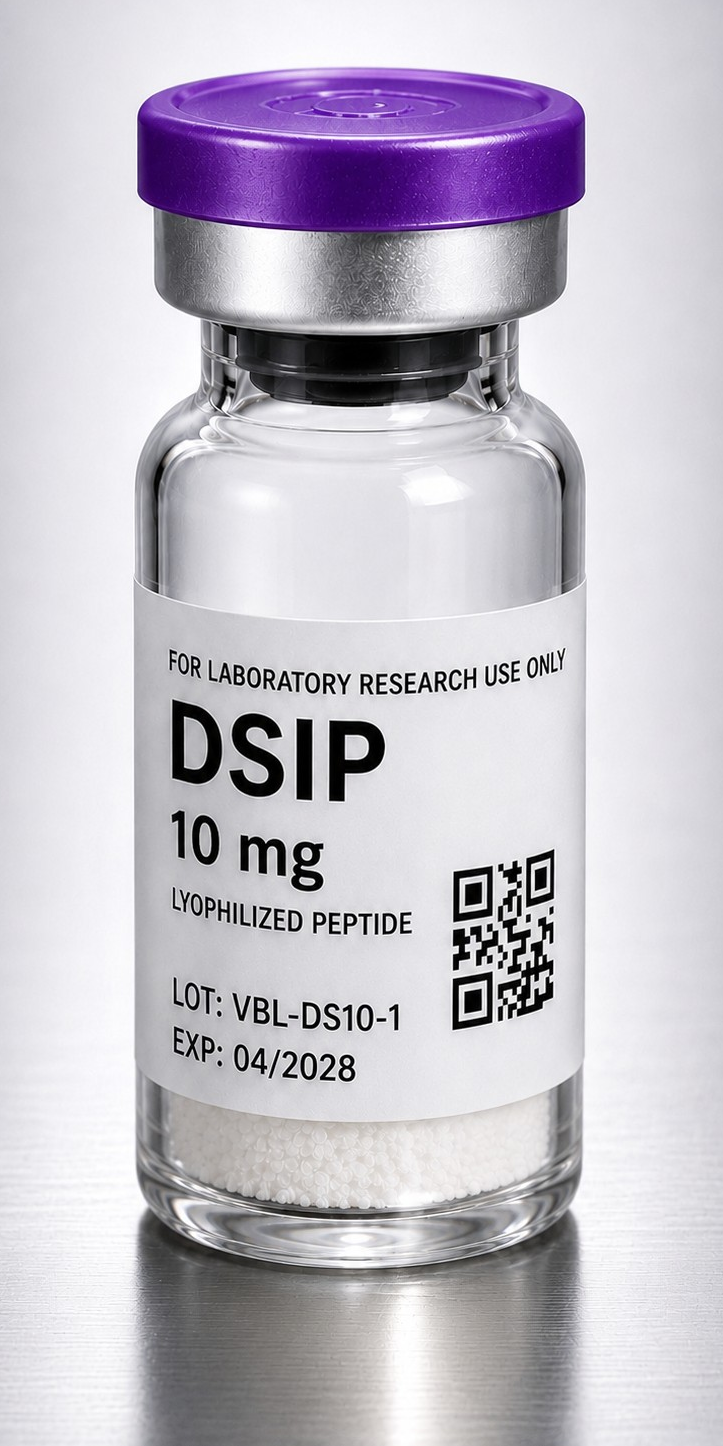
DSIP
REFERENCE STANDARD
Manufactured for Researchers Who Refuse to Compromise
Velora Biolabs manufactures, lyophilizes, packages, and fulfills research materials directly from our Wyoming laboratory.
Every production lot is assigned unique batch documentation, QR traceability, and lot-specific verification to support consistency and reproducibility.
Unlike suppliers relying on aging inventory and third-party fulfillment, Velora maintains direct oversight from production through shipment.
- Regular price
-
$29.00 - Sale price
-
$29.00
Couldn't load pickup availability



Scientific Background
Neuropeptide for Sleep-Cycle & Neuroendocrine Signaling Research
Category:
Neurocognitive Signaling • Circadian & Sleep Research • Stress-Response Biology
What Researchers Study
Delta Sleep-Inducing Peptide (DSIP) is an endogenous neuropeptide originally identified in mammalian brain tissue and later detected in human biological fluids. Researchers study DSIP for its role in sleep-wake regulation, neuroendocrine coordination, and central nervous system signaling.
In research settings, DSIP is investigated as a modulatory peptide rather than a classical sedative agent, with particular interest in how it influences sleep architecture, circadian rhythms, and stress-related neurochemical balance.
Primary Signal Pathways Studied
Scientific investigations of DSIP focus on its interaction with:
-
Sleep-related neural oscillations, including delta-wave and slow-wave activity
-
REM and non-REM sleep regulation pathways
-
Hypothalamic and neuroendocrine signaling, linked to circadian rhythm control
-
Stress-associated neurochemical systems, including dopaminergic and serotonergic pathways
-
Neuroprotective and adaptive signaling, particularly under sleep-disrupted conditions
DSIP is frequently studied for its regulatory influence on sleep structure, rather than direct hypnotic action.
Why This Peptide Is Studied
Sleep is governed by complex interactions between neural signaling, endocrine coordination, and circadian timing. Many compounds that influence sleep do so through broad suppression or stimulation, limiting mechanistic insight.
DSIP is studied because it appears to modulate sleep architecture and neuroendocrine balance, allowing researchers to explore:
-
Differences between sleep induction and sleep quality
-
The relationship between deep sleep stages and neural recovery
-
Interactions between sleep regulation and stress adaptation
This makes DSIP valuable in sleep physiology, circadian biology, and neurocognitive resilience research.
Research Areas of Interest
Sleep Architecture & Circadian Research
DSIP is examined in models assessing delta-wave activity, slow-wave sleep, REM/NREM balance, and circadian rhythm stability.
Neuroendocrine & Stress-Response Research
Because DSIP signaling appears to intersect with stress-associated neurochemical systems, it is studied in models evaluating adaptive responses to neurological or physiological stressors.
Neurocognitive & Behavioral Research
Exploratory research investigates how DSIP-related signaling may influence daytime alertness, cognitive performance, and neural recovery following sleep disruption.
Selected Scientific References
-
Graf et al., Sleep Research — Identification and characterization of DSIP in mammalian brain tissue
-
Monnier et al., Neuroscience Letters — DSIP and delta-wave modulation
-
Roffwarg et al., Journal of Sleep Research — Sleep architecture and neuropeptide signaling
-
Preclinical neuroendocrine literature — DSIP and hypothalamic regulation
(References provided for educational context and literature navigation.)
Product Specifications
-
Compound Name: Delta Sleep-Inducing Peptide (DSIP)
-
CAS Number: 62568-57-4
-
Molecular Formula: C₃₅H₄₈N₁₀O₁₅
-
Amino Acid Sequence: Trp-Ala-Gly-Gly-Asp-Ala-Ser-Gly-Glu
-
Molecular Weight: 848.81 Da
-
Purity: ≥98% (HPLC verified)
-
Form: Lyophilized powder
-
Appearance: White to off-white solid
-
Storage: ≤ –20 °C, desiccated, protected from light
Batch Documentation & Traceability
Each vial is shipped with a lot-specific QR code that provides secure access to batch documentation, including:
• Certificate of Analysis (COA)
• Identity verification report (HPLC / MS)
• Lot number, potency, and expiration
Documentation is locked to the specific batch shipped to ensure traceability, version control, and research reproducibility.
QR access is provided with the physical product and is not reused across lots.
Research Use Disclaimer
This product is supplied strictly for laboratory research and in-vitro or preclinical investigation.
Not for human or veterinary use.
Not for diagnostic, therapeutic, or consumptive applications.