

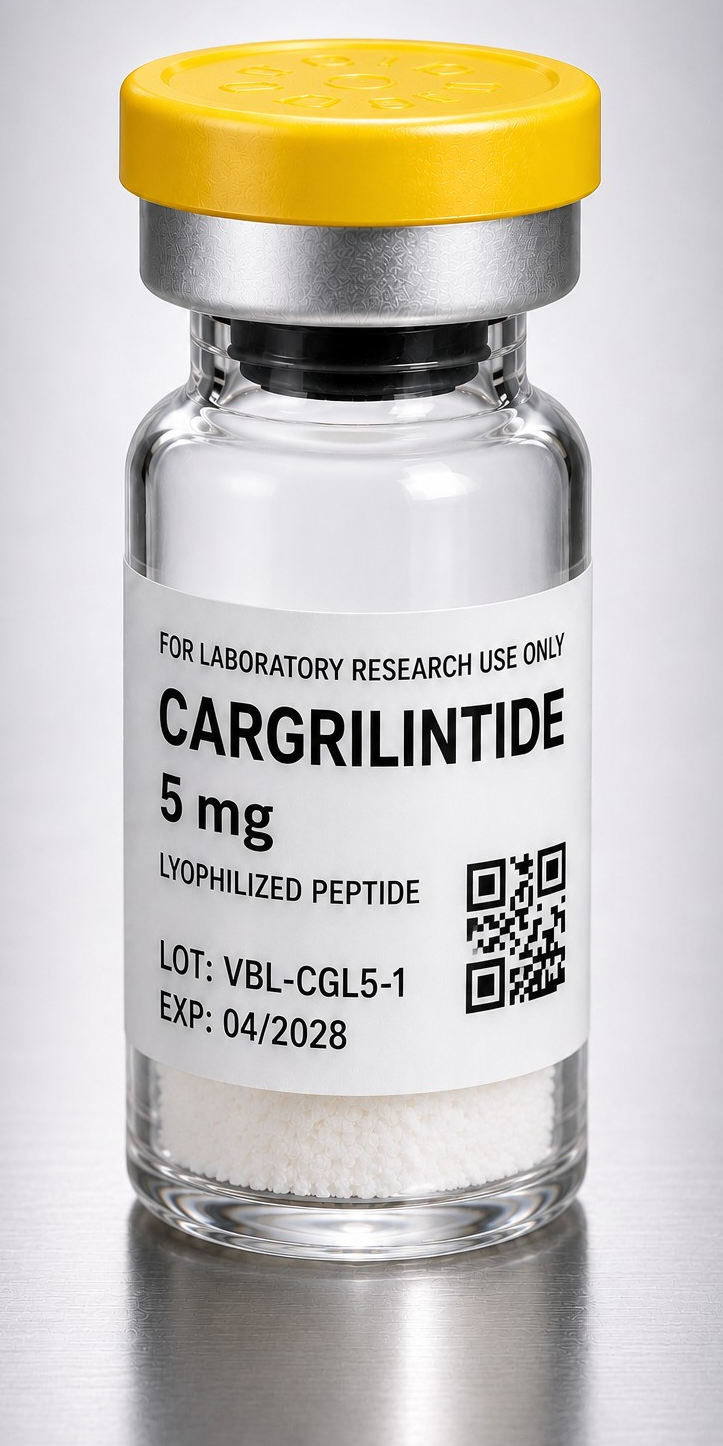
CARGRILINTIDE
REFERENCE STANDARD
Manufactured for Researchers Who Refuse to Compromise
Velora Biolabs manufactures, lyophilizes, packages, and fulfills research materials directly from our Wyoming laboratory.
Every production lot is assigned unique batch documentation, QR traceability, and lot-specific verification to support consistency and reproducibility.
Unlike suppliers relying on aging inventory and third-party fulfillment, Velora maintains direct oversight from production through shipment.
- Regular price
-
$49.00 - Sale price
-
$49.00
Couldn't load pickup availability

Scientific Background
Long-Acting Amylin Analog for Metabolic & Appetite Signaling Research
Category:
Metabolic Signaling • Appetite & Energy Regulation • Endocrine Research
What Researchers Study
Cagrilintide is a long-acting synthetic peptide analog of amylin, a hormone co-secreted with insulin that plays a role in appetite regulation, gastric emptying, and energy balance. Researchers study cagrilintide to better understand central and peripheral satiety signaling and how amylin receptor modulation influences metabolic behavior in preclinical models.
The peptide is structurally modified to enhance stability and extend biological activity compared to native amylin, making it suitable for sustained signaling studies.
Primary Signal Pathways Studied
Research involving cagrilintide focuses on:
-
Amylin receptor activation (AMY receptors, composed of calcitonin receptor complexes)
-
Central appetite and satiety signaling, particularly within hypothalamic pathways
-
Gastric emptying and nutrient flow regulation
-
Energy balance and metabolic coordination, especially in obesity and metabolic-dysregulation models
Cagrilintide is frequently studied alongside other metabolic peptides to examine complementary or overlapping signaling mechanisms.
Why This Peptide Is Studied
Native amylin has a short half-life and limited stability, restricting its usefulness in extended research models. Cagrilintide was developed to allow researchers to:
-
Examine sustained amylin receptor signaling
-
Study appetite regulation independently of insulin or incretin pathways
-
Explore combinatorial metabolic signaling strategies in preclinical systems
Its long-acting design makes it valuable for comparative metabolic research and energy-regulation modeling.
Research Areas of Interest
Appetite & Satiety Signaling
Cagrilintide is widely studied in models investigating central appetite control, food-intake behavior, and satiety-related neural circuits.
Metabolic & Energy Balance Research
Research explores how amylin analogs influence body-weight regulation, nutrient handling, and systemic metabolic coordination.
Combination Peptide Research
Cagrilintide is often examined in combination frameworks to understand how amylin signaling interacts with other endocrine or metabolic pathways.
Selected Scientific References
-
Larsen et al., Diabetes, Obesity and Metabolism — Amylin analogs and appetite regulation
-
Holst et al., Nature Reviews Endocrinology — Central mechanisms of metabolic peptide signaling
-
Amylin receptor signaling literature — Calcitonin receptor complex biology
(References provided for educational context and literature navigation.)
Product Specifications
-
Compound Name: Cagrilintide
-
CAS Number: 1415456-99-3
-
Molecular Formula: C₁₉₄H₃₁₂N₅₄O₅₉S₂
-
Amino Acid Sequence:
{Eicosanedioic acid-γ-Glu}-Lys-Cys-Asn-Thr-Ala-Thr-Cys-Ala-Thr-Gln-Arg-Leu-Ala-Glu-Phe-Leu-Arg-His-Ser-Ser-Asn-Asn-Phe-Gly-Pro-Ile-Leu-Pro-Pro-Thr-Asn-Val-Gly-Ser-Asn-Thr-Pro-NH₂
-
Molecular Weight: ~4,409 Da
-
Purity: ≥98% (HPLC verified)
-
Form: Lyophilized powder
-
Appearance: White to off-white solid
-
Storage: ≤ –20 °C, desiccated, protected from light
Batch Documentation & Traceability
Each vial is shipped with a lot-specific QR code that provides secure access to batch documentation, including:
• Certificate of Analysis (COA)
• Identity verification report (HPLC / MS)
• Lot number, potency, and expiration
Documentation is locked to the specific batch shipped to ensure traceability, version control, and research reproducibility.
QR access is provided with the physical product and is not reused across lots.
Research Use Disclaimer
This product is supplied strictly for laboratory research and in-vitro or preclinical investigation.
Not for human or veterinary use.
Not for diagnostic, therapeutic, or consumptive applications.