
BPC-157
REFERENCE STANDARD
Manufactured for Researchers Who Refuse to Compromise
Velora Biolabs manufactures, lyophilizes, packages, and fulfills research materials directly from our Wyoming laboratory.
Every production lot is assigned unique batch documentation, QR traceability, and lot-specific verification to support consistency and reproducibility.
Unlike suppliers relying on aging inventory and third-party fulfillment, Velora maintains direct oversight from production through shipment.
- Regular price
-
$49.00 - Sale price
-
$49.00
Couldn't load pickup availability

Scientific Background
Pentadecapeptide for Tissue Repair & Systemic Signaling Research
Category:
Tissue Repair & Regenerative Signaling • Gastrointestinal Biology • Neurovascular Research • Peptide Research Compounds
What Researchers Study
BPC-157 (Body Protection Compound-157) is a synthetic pentadecapeptide composed of 15 amino acids, modeled after a protective peptide sequence identified in human gastric tissue. Researchers study BPC-157 for its broad role in tissue repair signaling, vascular integrity, and cellular resilience across multiple biological systems.
Unlike peptides that act on a single receptor or pathway, BPC-157 is investigated for its system-wide signaling effects, particularly in models involving injury, inflammation, and compromised tissue repair.
Primary Signal Pathways Studied
Research indicates that BPC-157 interacts with multiple biological signaling systems, including:
-
Angiogenic signaling, particularly via modulation of VEGF-related pathways
-
Growth factor signaling, including interactions with EGF, FGF, and TGF-β cascades
-
Nitric oxide (NO) pathways, influencing vascular tone and blood flow regulation
-
Neurotransmitter-associated signaling, including serotonergic and dopaminergic systems
These interactions make BPC-157 a valuable research tool for studying coordinated tissue repair and vascular adaptation rather than isolated cellular effects.
Why This Peptide Is Studied
Many injury and degeneration models involve overlapping dysfunction across blood vessels, connective tissue, nerves, and inflammatory signaling. Traditional compounds often address only one component of this process.
BPC-157 is studied because it appears to coordinate repair signaling across multiple systems simultaneously, allowing researchers to explore how vascular repair, extracellular matrix remodeling, and neural signaling interact during recovery and regeneration.
Research Areas of Interest
Musculoskeletal & Connective Tissue Research
BPC-157 is widely studied in tendon, ligament, muscle, and bone models, particularly for its influence on collagen organization, angiogenesis, and structural integrity during repair.
Gastrointestinal & Barrier Integrity Research
Because BPC-157 is modeled after a gastric-derived peptide, it is frequently studied in gastrointestinal injury models, including gastric mucosal protection and intestinal barrier signaling.
Neurological & Neurovascular Research
Emerging research explores BPC-157’s role in neuroprotection, nerve regeneration, and neurovascular coupling in both central and peripheral nervous system models.
Selected Scientific References
-
Seiwerth et al., Journal of Physiology and Pharmacology — Systemic tissue repair and angiogenic signaling associated with BPC-157
-
Sikiric et al., Current Pharmaceutical Design — Gastrointestinal protection and nitric oxide modulation
-
Park et al., Neuropeptides — Neuroprotective and neurotransmitter-associated signaling effects
-
Amic et al., Digestive Diseases and Sciences — Gastric cytoprotection and mucosal repair models
(References provided for educational context and literature navigation.)
Product Specifications
-
Compound Name: BPC-157 (Body Protection Compound-157)
-
CAS Number: 137525-51-0
-
Molecular Formula: C₆₂H₉₈N₁₆O₂₂
-
Amino Acid Sequence: Gly-Glu-Pro-Pro-Pro-Gly-Lys-Pro-Ala-Asp-Asp-Ala-Gly-Leu-Val
-
Molecular Weight: ~1,419.56 Da
-
Purity: ≥99% (HPLC verified)
-
Form: Lyophilized powder
-
Appearance: White to off-white solid
-
Storage: ≤ –20 °C, desiccated, protected from light
Batch Documentation & Traceability
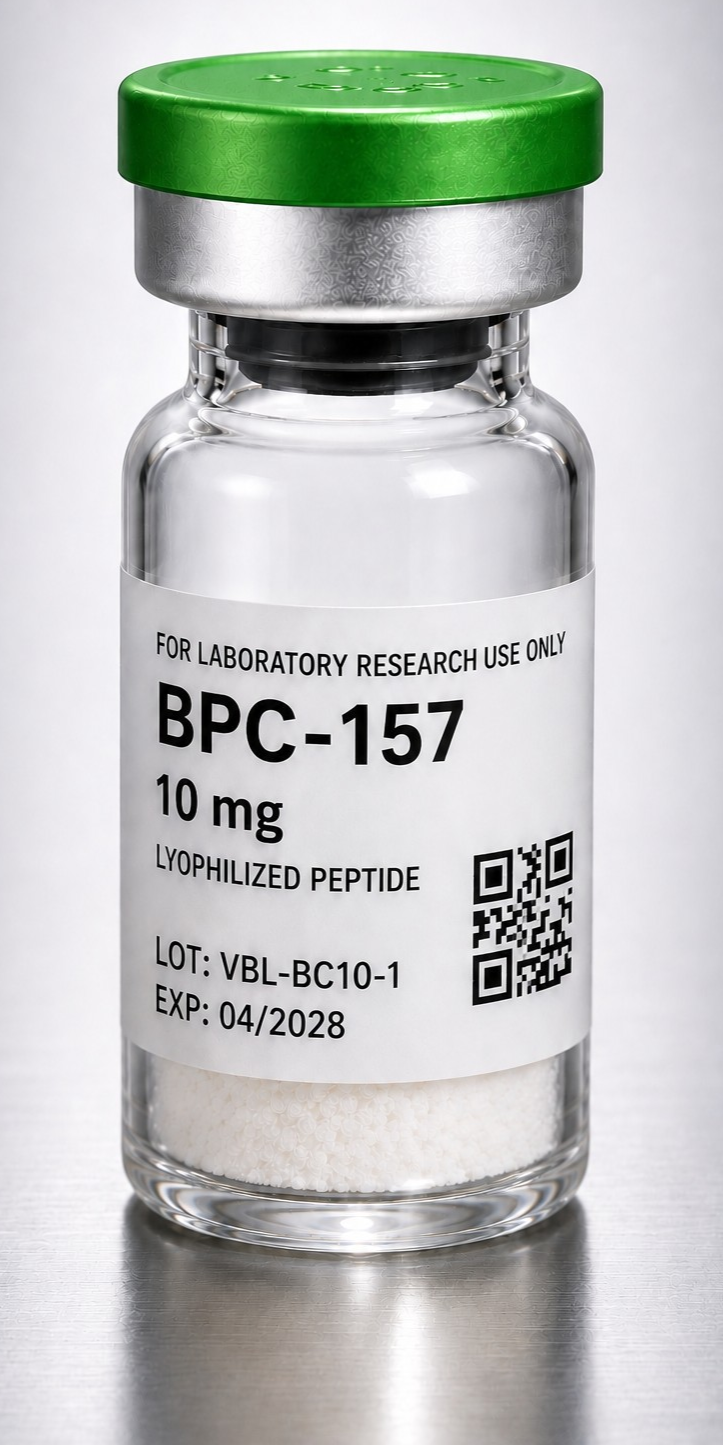
Each vial is shipped with a lot-specific QR code that provides secure access to batch documentation, including:
• Certificate of Analysis (COA)
• Identity verification report (HPLC / MS)
• Lot number, potency, and expiration
Documentation is locked to the specific batch shipped to ensure traceability, version control, and research reproducibility.
QR access is provided with the physical product and is not reused across lots.
Research Use Disclaimer
This product is supplied strictly for laboratory research and in-vitro or preclinical investigation.
Not for human or veterinary use.
Not for diagnostic, therapeutic, or consumptive applications.