

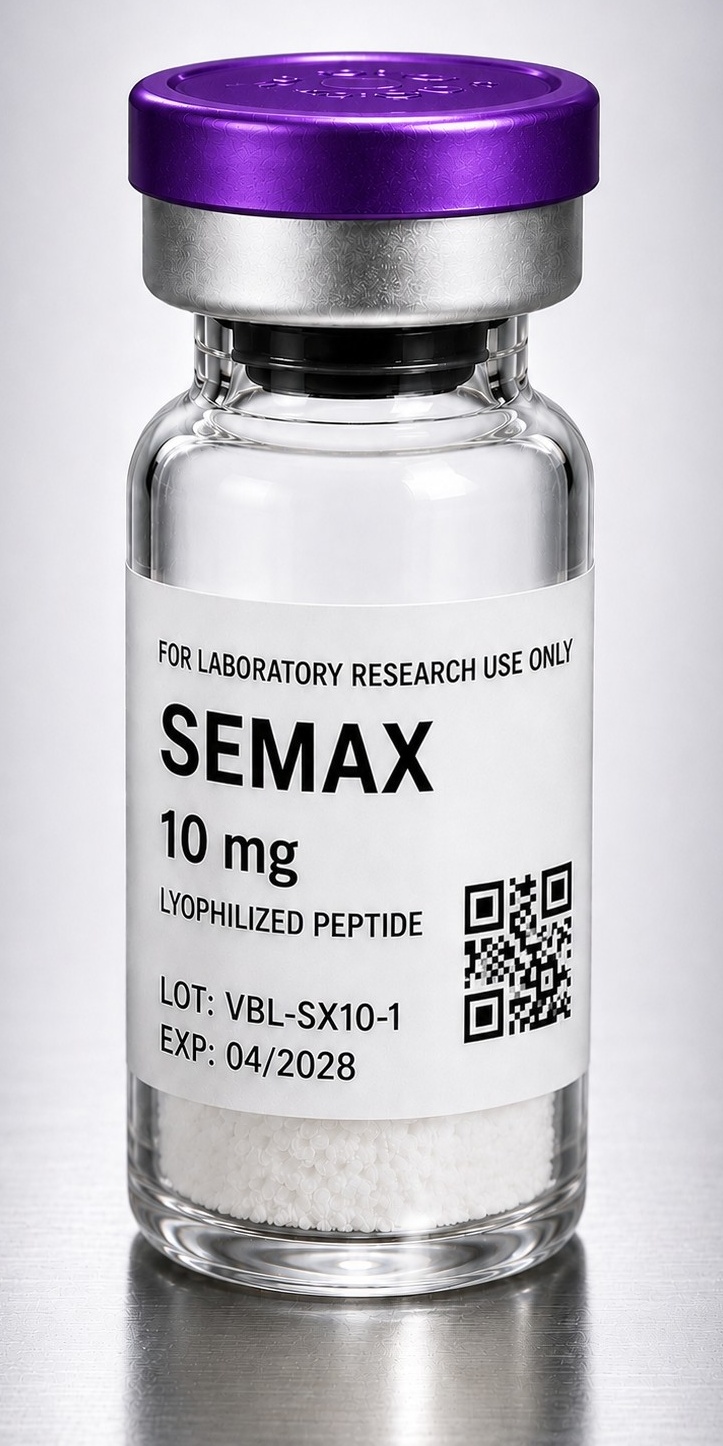
SEMAX
REFERENCE STANDARD
Manufactured for Researchers Who Refuse to Compromise
Velora Biolabs manufactures, lyophilizes, packages, and fulfills research materials directly from our Wyoming laboratory.
Every production lot is assigned unique batch documentation, QR traceability, and lot-specific verification to support consistency and reproducibility.
Unlike suppliers relying on aging inventory and third-party fulfillment, Velora maintains direct oversight from production through shipment.
- Regular price
-
$49.00 - Sale price
-
$49.00
Couldn't load pickup availability

Scientific Background
Cognitive Enhancement, Neuroprotection & BDNF Signaling Research
Category:
Neuropeptide Signaling • Cognitive Neuroscience • Neuroprotection • Stress & Plasticity Research
What Researchers Study
Semax is a synthetic heptapeptide (Met-Glu-His-Phe-Pro-Gly-Pro) derived from a fragment of adrenocorticotropic hormone (ACTH 4–10), engineered to retain central neurotrophic and cognitive effects without stimulating corticosteroid release.
Researchers study Semax because it:
-
Robustly upregulates BDNF expression
-
Enhances learning and memory formation
-
Exhibits neuroprotective effects in ischemic and traumatic models
-
Modulates stress and emotional regulation without sedation
-
Supports neuronal survival without endocrine disruption
Semax is considered a reference compound in preclinical neuroplasticity research.
Primary Signal Pathways Studied
-
BDNF / TrkB signaling
-
Synaptic plasticity and memory consolidation
-
Glutamatergic excitotoxicity modulation
-
Dopaminergic and serotonergic balance
-
Antioxidant and anti-apoptotic gene expression
-
HPA axis modulation (non-steroidogenic)
Why This Molecule Is Studied
Unlike stimulants or sedatives, Semax:
-
Enhances cognition without psychostimulation
-
Reduces anxiety without sedation
-
Protects neurons without suppressing normal signaling
-
Acts via gene expression and trophic support, not acute receptor forcing
This makes it ideal for longitudinal cognitive, recovery, and resilience studies.
Mechanistic Overview
Semax acts primarily as a neurotrophic modulator, not a classical neurotransmitter agonist.
Key mechanisms include:
-
Upregulation of BDNF and NGF
-
Enhancement of synaptic protein synthesis
-
Reduction of glutamate-induced excitotoxic damage
-
Increased resistance to oxidative stress
-
Stabilization of neuronal metabolic demand
Importantly, Semax does not activate ACTH-mediated cortisol release, distinguishing it from native ACTH peptides.
Key Research Domains
1. Cognitive Function & Memory Formation
Semax is widely studied in:
-
Learning acquisition models
-
Memory consolidation paradigms
-
Attention and executive function research
Often used in Morris water maze, passive avoidance, and object recognition tests.
2. Neuroprotection & Ischemic Injury
Semax demonstrates protective effects in:
-
Cerebral ischemia and stroke models
-
Traumatic brain injury (TBI)
-
Hypoxia-induced neuronal stress
Used to study neuronal survival, infarct size reduction, and functional recovery.
3. Stress Resilience & Emotional Regulation
Semax is investigated for:
-
Anxiety-like behavior reduction
-
Stress-induced cognitive impairment prevention
-
Adaptive HPA axis modulation
Notably, effects occur without motor impairment or sedation.
4. Ophthalmic & Retinal Neuroprotection
Because the retina is CNS-derived, Semax is studied in:
-
Optic nerve injury models
-
Retinal ischemia
-
Glaucoma and neurodegenerative eye research
Supports retinal ganglion cell survival and visual pathway integrity.
Product Specifications
-
Compound Name: Semax
-
CAS Number: 80714-61-0
-
Molecular Formula: C₃₇H₅₁N₉O₁₀S
-
Molecular Weight: 813.92 Da
-
Amino Acid Sequence: Met-Glu-His-Phe-Pro-Gly-Pro
-
Peptide Class: Synthetic ACTH-derived heptapeptide
-
Purity: ≥99% (HPLC verified)
-
Form: Lyophilized powder
-
Appearance: White to off-white solid
-
Storage: ≤ –20 °C, desiccated, protected from light
Batch Documentation & Traceability
Each vial is shipped with a lot-specific QR code that provides secure access to batch documentation, including:
• Certificate of Analysis (COA)
• Identity verification report (HPLC / MS)
• Lot number, potency, and expiration
Documentation is locked to the specific batch shipped to ensure traceability, version control, and research reproducibility.
QR access is provided with the physical product and is not reused across lots.
Research Use Disclaimer
This compound is supplied exclusively for laboratory research use.
Not for human or veterinary use.
Not for diagnostic, therapeutic, or consumptive applications.