

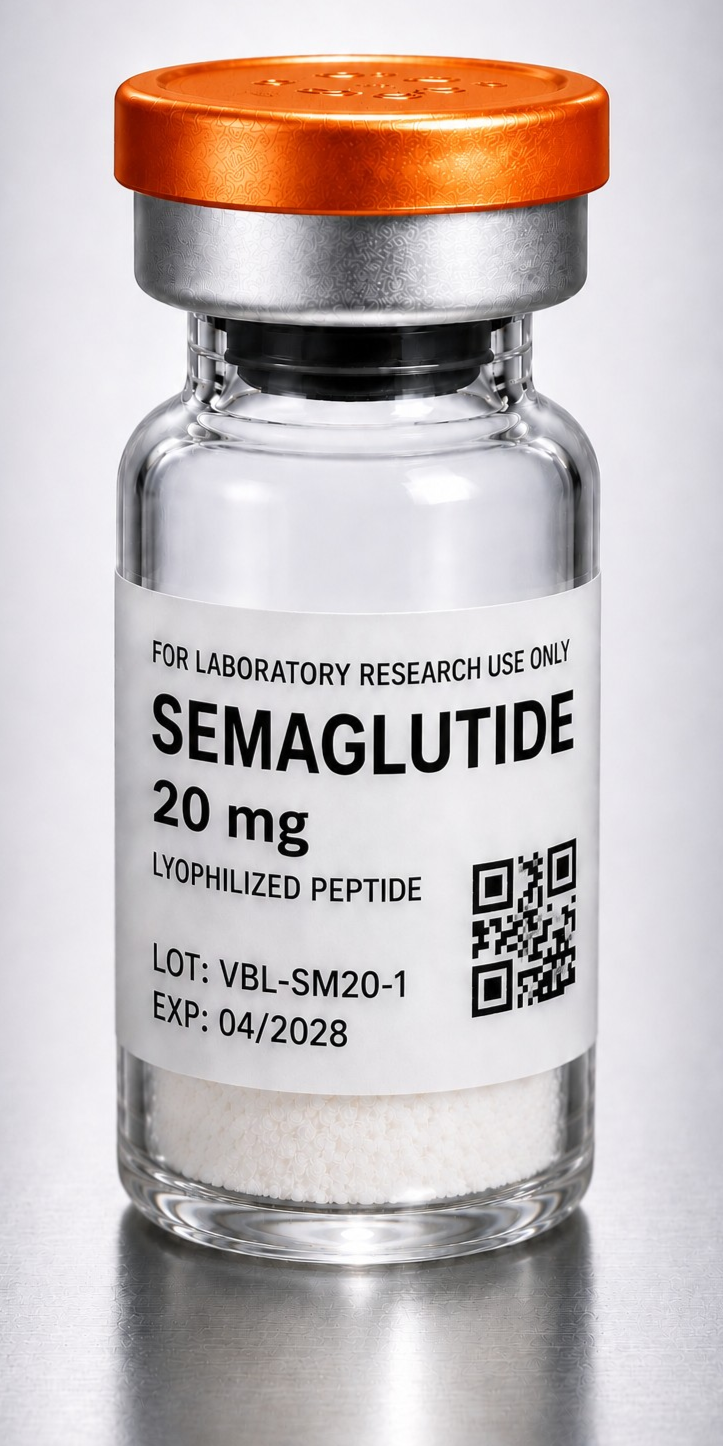
SEMAGLUTIDE
REFERENCE STANDARD
Manufactured for Researchers Who Refuse to Compromise
Velora Biolabs manufactures, lyophilizes, packages, and fulfills research materials directly from our Wyoming laboratory.
Every production lot is assigned unique batch documentation, QR traceability, and lot-specific verification to support consistency and reproducibility.
Unlike suppliers relying on aging inventory and third-party fulfillment, Velora maintains direct oversight from production through shipment.
- Regular price
-
$89.00 - Sale price
-
$89.00
Couldn't load pickup availability

Scientific Background
Incretin Signaling, Glucose Homeostasis & Appetite Regulation Research
Category:
Metabolic Signaling • Incretin Biology • Glucose Regulation • Energy Balance Research
What Researchers Study
Semaglutide is a long-acting synthetic glucagon-like peptide-1 (GLP-1) receptor agonist engineered to resist enzymatic degradation and exhibit prolonged systemic activity via albumin binding.
Researchers study Semaglutide because it enables:
-
Precise investigation of GLP-1 receptor biology
-
Long-duration incretin signaling models
-
Appetite and satiety pathway mapping
-
Glucose regulation independent of insulin analogs
Its extended half-life makes it especially valuable for chronic metabolic and longitudinal studies.
Primary Signal Pathways Studied
-
GLP-1 receptor (GLP-1R) activation
-
Central appetite and satiety signaling
-
Pancreatic β-cell insulin secretion
-
Glucagon suppression
-
Gastric emptying modulation
-
Brain–gut axis integration
Why This Molecule Is Studied
Semaglutide is studied as a reference-grade GLP-1 agonist because it offers:
-
High receptor specificity
-
Predictable pharmacokinetics
-
Sustained signaling without continuous dosing
-
Clear separation of incretin effects vs caloric restriction
It is frequently used as a benchmark compound when evaluating newer dual- or triple-agonist peptides.
Mechanistic Overview
Semaglutide binds the GLP-1 receptor, a class B G-protein–coupled receptor expressed in:
-
Pancreatic islets
-
Hypothalamic appetite centers
-
Gastrointestinal tract
Activation leads to:
-
Glucose-dependent insulin secretion
-
Suppression of glucagon release
-
Delayed gastric emptying
-
Central satiety signaling
Structural modifications (fatty-acid acylation) enable albumin binding, dramatically extending circulation time and signaling duration.
Key Research Domains
1. Glucose Homeostasis & Insulin Sensitivity
Used to study:
-
Post-prandial glucose handling
-
β-cell functional capacity
-
Glucose-dependent insulin secretion
Common endpoints include fasting glucose, insulin curves, and clamp studies.
2. Appetite & Energy Intake Regulation
Semaglutide is widely used in:
-
Feeding behavior models
-
Hypothalamic signaling studies
-
Brainstem appetite circuit mapping
Allows isolation of central satiety signaling without stimulant or aversive pathways.
3. Weight & Adiposity Research
Frequently applied in:
-
Obesity and diet-induced weight gain models
-
Visceral vs subcutaneous fat analysis
-
Lean mass preservation studies
Often paired with DEXA, MRI, or histological analysis.
4. Comparative Incretin Biology
Semaglutide serves as a control or comparator for:
-
Dual agonists (GLP-1/GIP)
-
Triple agonists (GLP-1/GIP/Glucagon)
-
Short-acting GLP-1 analogs
Research Context Considerations
-
Effects are dose- and duration-dependent
-
Chronic exposure yields different outcomes than acute dosing
-
Central vs peripheral signaling contributions vary by model
-
Species-specific GLP-1 receptor distribution should be considered
Product Specifications
-
Compound Name: Semaglutide
-
CAS Number: 910463-68-2
-
Molecular Formula: C₁₈₇H₂₉₁N₄₅O₅₉
-
Molecular Weight: 4,113.64 Da
-
Peptide Class: Long-acting GLP-1 receptor agonist
-
Purity: ≥98% (HPLC verified)
-
Form: Lyophilized powder
-
Appearance: White to off-white solid
-
Storage: ≤ –20 °C, desiccated, protected from light
Batch Documentation & Traceability
Each vial is shipped with a lot-specific QR code that provides secure access to batch documentation, including:
• Certificate of Analysis (COA)
• Identity verification report (HPLC / MS)
• Lot number, potency, and expiration
Documentation is locked to the specific batch shipped to ensure traceability, version control, and research reproducibility.
QR access is provided with the physical product and is not reused across lots.
Research Use Disclaimer
This compound is supplied exclusively for laboratory research use.
Not for human or veterinary use.
Not for diagnostic, therapeutic, or consumptive applications.