

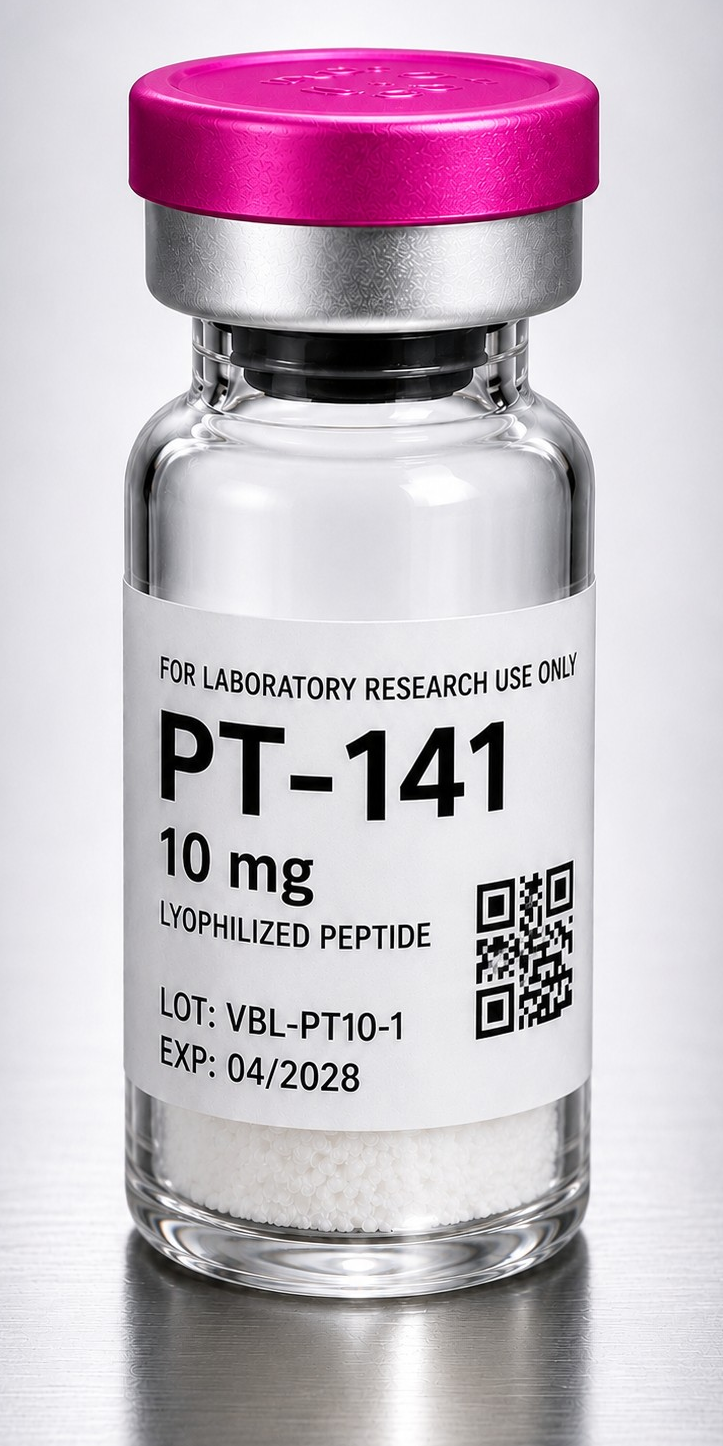
PT-141
REFERENCE STANDARD
Manufactured for Researchers Who Refuse to Compromise
Velora Biolabs manufactures, lyophilizes, packages, and fulfills research materials directly from our Wyoming laboratory.
Every production lot is assigned unique batch documentation, QR traceability, and lot-specific verification to support consistency and reproducibility.
Unlike suppliers relying on aging inventory and third-party fulfillment, Velora maintains direct oversight from production through shipment.
- Regular price
-
$39.00 - Sale price
-
$39.00
Couldn't load pickup availability

Scientific Background
Central Nervous System Melanocortin Signaling, Neuroendocrine & Behavioral Modulation Research
Category:
Neuroendocrine Signaling • Melanocortin Receptor Biology • Behavioral Neuroscience • Autonomic Regulation Research
What Researchers Study
PT-141 (Bremelanotide) is a synthetic heptapeptide melanocortin receptor agonist and an active metabolite of Melanotan II, engineered to preferentially target central melanocortin pathways rather than peripheral pigmentation mechanisms.
Researchers study PT-141 because it:
-
Crosses the blood–brain barrier
-
Preferentially activates MC4R and MC3R
-
Produces central nervous system effects independent of peripheral vasodilation
-
Allows isolation of melanocortin-driven behavioral and autonomic signaling
This makes PT-141 uniquely valuable for studying motivation, reward, autonomic tone, and neuroendocrine integration.
Primary Signal Pathways Studied
PT-141 research focuses on:
-
Melanocortin-4 receptor (MC4R) signaling
-
Melanocortin-3 receptor (MC3R) modulation
-
Hypothalamic neural circuit activation
-
Dopaminergic reward pathway interaction
-
Nitric oxide signaling within CNS nuclei
-
Sympathetic–parasympathetic balance
Why This Molecule Is Studied
Unlike many peptides that act peripherally, PT-141 is studied specifically because it:
-
Produces direct central effects
-
Separates melanocortin behavioral signaling from MC1R-driven pigmentation
-
Allows examination of brain-initiated autonomic responses
-
Exhibits predictable, receptor-specific activation profiles
Its CNS penetrance enables precise mechanistic study of melanocortin-driven behaviors without confounding peripheral pathways.
Mechanistic Overview
PT-141 binds primarily to MC4R, a G-protein–coupled receptor densely expressed in:
-
Hypothalamus
-
Limbic system
-
Brainstem autonomic nuclei
Activation leads to:
-
Increased neuronal firing (c-Fos expression)
-
Modulation of dopaminergic tone
-
Altered autonomic output
-
Context-dependent behavioral changes
Notably, PT-141 does not rely on nitric-oxide–mediated peripheral vasodilation, distinguishing it from erectile-focused compounds and making it ideal for central signaling research.
Key Research Domains
1. Central Nervous System Activation
Studies demonstrate:
-
Rapid BBB penetration
-
Hypothalamic neuron activation
-
Sustained receptor engagement over hours
PT-141 is frequently used in c-Fos mapping and receptor localization studies.
2. Behavioral & Motivational Neuroscience
PT-141 is used to study:
-
Motivated behavior
-
Reward valuation
-
Effort-based task performance
-
Behavioral state modulation
Its effects are state-dependent, making it useful for dissecting contextual neural responses.
3. Autonomic & Neuroendocrine Regulation
Research shows:
-
Central sympathetic activation
-
Modulation of cardiovascular parameters
-
Thermoregulatory effects via hypothalamic MC4R signaling
This positions PT-141 as a tool for brain-initiated autonomic control research.
Research Context Considerations
-
Effects are dose- and context-dependent
-
Behavioral outcomes vary by species and baseline state
-
Circadian timing influences response magnitude
-
MC4R-deficient models show blunted or absent effects
Product Specifications
-
Compound Name: PT-141 (Bremelanotide)
-
CAS Number: 1607799-13-2
-
Molecular Formula: C₅₀H₆₈N₁₄O₁₀
-
Molecular Weight: 1085.2 Da (acetate)
-
Peptide Class: Melanocortin receptor agonist
-
Purity: ≥98% (HPLC verified)
-
Form: Lyophilized powder
-
Appearance: White to off-white solid
-
Storage: ≤ –20 °C, desiccated, protected from light
Batch Documentation & Traceability
Each vial is shipped with a lot-specific QR code that provides secure access to batch documentation, including:
• Certificate of Analysis (COA)
• Identity verification report (HPLC / MS)
• Lot number, potency, and expiration
Documentation is locked to the specific batch shipped to ensure traceability, version control, and research reproducibility.
QR access is provided with the physical product and is not reused across lots.
Research Use Disclaimer
This compound is supplied exclusively for laboratory research use.
Not for human or veterinary use.
Not for diagnostic, therapeutic, or consumptive applications.