

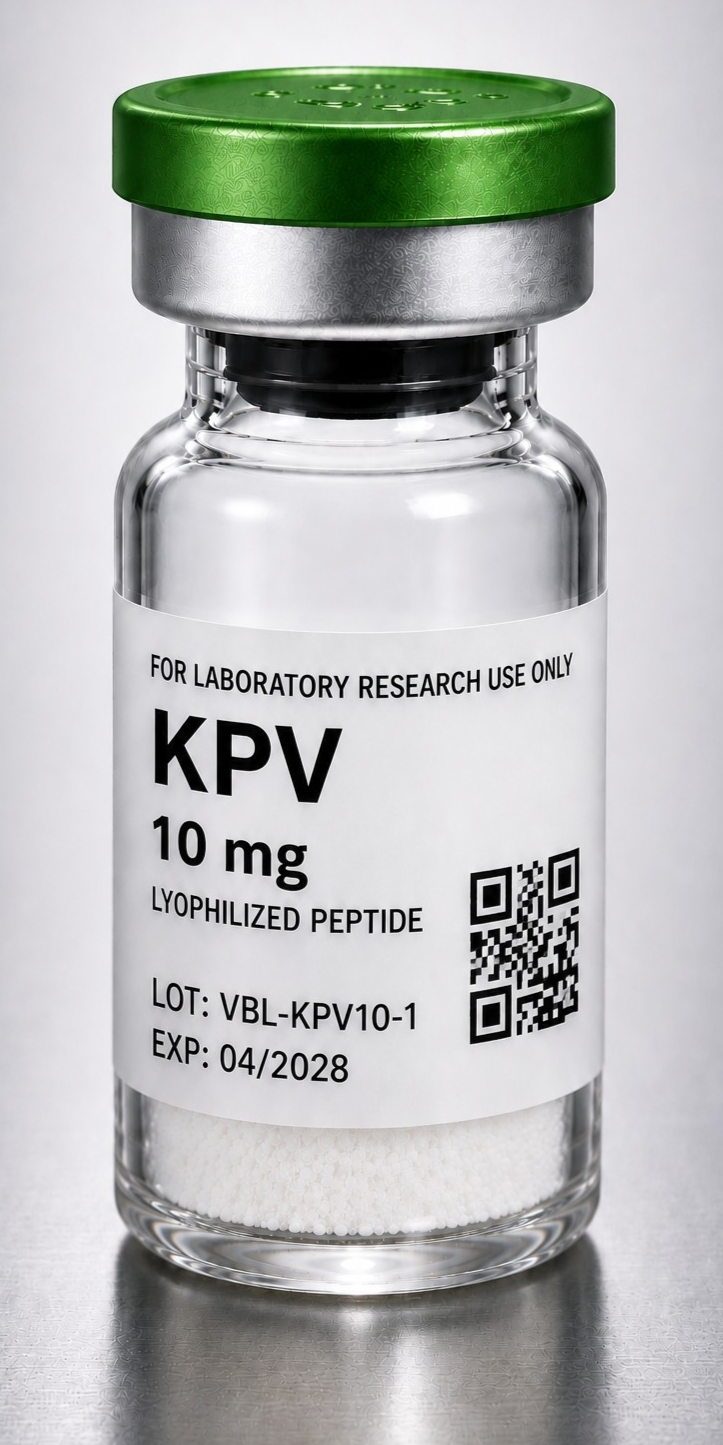
KPV
REFERENCE STANDARD
Manufactured for Researchers Who Refuse to Compromise
Velora Biolabs manufactures, lyophilizes, packages, and fulfills research materials directly from our Wyoming laboratory.
Every production lot is assigned unique batch documentation, QR traceability, and lot-specific verification to support consistency and reproducibility.
Unlike suppliers relying on aging inventory and third-party fulfillment, Velora maintains direct oversight from production through shipment.
- Regular price
-
$34.00 - Sale price
-
$34.00
Couldn't load pickup availability

Scientific Background
α-MSH–Derived Tripeptide for Inflammatory Modulation & Barrier-Integrity Research
Category:
Immunological & Inflammatory Signaling • Barrier & Epithelial Biology • Neuroimmune Research
What Researchers Study
KPV (Lysine-Proline-Valine) is a bioactive tripeptide fragment derived from the C-terminal sequence of α-Melanocyte-Stimulating Hormone (α-MSH). Researchers study KPV for its role in inflammatory regulation, immune signaling balance, and epithelial barrier integrity.
Unlike full-length α-MSH, KPV retains key regulatory properties while exhibiting greater stability and simplicity, making it a useful tool for mechanistic inflammation research across multiple tissue systems.
Primary Signal Pathways Studied
Research involving KPV focuses on its interaction with:
-
NF-κB signaling pathways, central to inflammatory cytokine production
-
Melanocortin receptor signaling, particularly MC1R and MC3R modulation
-
Cytokine regulation, including TNF-α, IL-1β, and IL-6 signaling dynamics
-
Oxidative stress modulation, linked to inflammatory tissue damage
-
Epithelial tight-junction regulation, supporting barrier integrity
KPV is frequently studied as a downstream regulatory fragment, influencing inflammatory tone rather than initiating broad immune activation.
Why This Peptide Is Studied
Chronic inflammation and barrier dysfunction are core drivers of many degenerative and autoimmune processes. Many anti-inflammatory agents suppress immune activity broadly, limiting mechanistic clarity.
KPV is studied because it allows researchers to:
-
Examine targeted inflammatory modulation without global immunosuppression
-
Investigate how melanocortin-derived fragments regulate immune balance
-
Explore the link between barrier integrity and inflammatory signaling
-
Study inflammation in epithelial-rich systems such as skin and gut
This positions KPV as a valuable research tool in immunology, barrier biology, and neuroimmune signaling.
Research Areas of Interest
Inflammatory & Immune Regulation
KPV is widely studied in models of localized and systemic inflammation, including immune-cell activation and cytokine signaling dynamics.
Gastrointestinal & Barrier Biology
Research explores KPV’s role in intestinal epithelial integrity, tight-junction signaling, and mucosal repair processes.
Dermal & Epithelial Research
KPV is examined in skin and wound-healing models for its influence on keratinocyte migration, collagen organization, and inflammatory resolution.
Neuroimmune & Oxidative Stress Research
Emerging research investigates how KPV-related signaling intersects with neuroinflammation and oxidative stress pathways.
Selected Scientific References
-
Dalmasso et al., Inflammatory Bowel Diseases — NF-κB inhibition by KPV in epithelial cells
-
Brzoska et al., Experimental Neurology — α-MSH–derived peptides and microglial inflammation
-
Böhm et al., Journal of Investigative Dermatology — Keratinocyte migration and melanocortin signaling
-
Wang et al., American Journal of Physiology — Intestinal barrier function and tight-junction regulation
(References provided for educational context and literature navigation.)
Product Specifications
-
Compound Name: KPV (Lysine-Proline-Valine)
-
CAS Number: 67727-97-3
-
Molecular Formula: C₁₇H₃₂N₆O₄
-
Amino Acid Sequence: Lys-Pro-Val
-
Molecular Weight: 384.48 Da
-
Purity: ≥98% (HPLC verified)
-
Form: Lyophilized powder
-
Appearance: White to off-white solid
-
Storage: ≤ –20 °C, desiccated, protected from light
Batch Documentation & Traceability
Each vial is shipped with a lot-specific QR code that provides secure access to batch documentation, including:
• Certificate of Analysis (COA)
• Identity verification report (HPLC / MS)
• Lot number, potency, and expiration
Documentation is locked to the specific batch shipped to ensure traceability, version control, and research reproducibility.
QR access is provided with the physical product and is not reused across lots.
Research Use Disclaimer
This product is supplied strictly for laboratory research and in-vitro or preclinical investigation.
Not for human or veterinary use.
Not for diagnostic, therapeutic, cosmetic, or consumptive applications.