

GLUTATHIONE
REFERENCE STANDARD
Manufactured for Researchers Who Refuse to Compromise
Velora Biolabs manufactures, lyophilizes, packages, and fulfills research materials directly from our Wyoming laboratory.
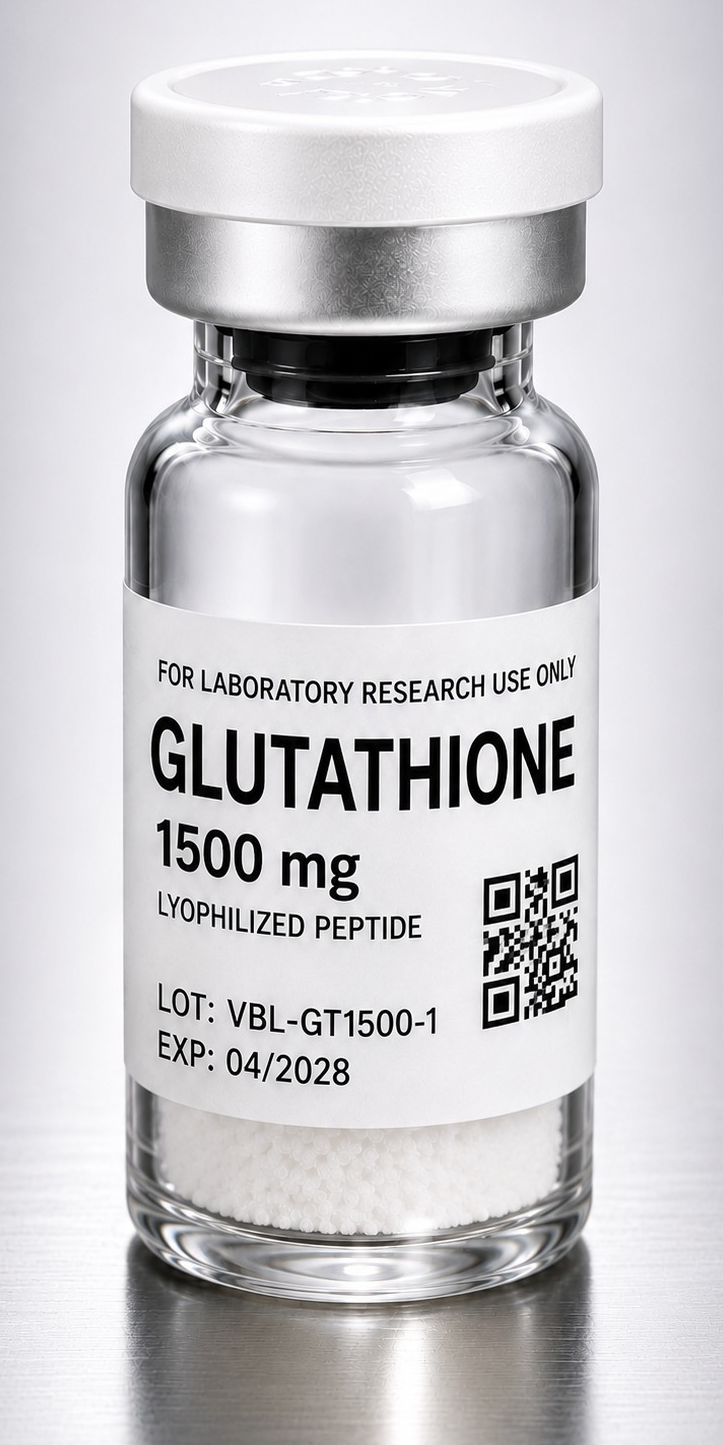
Every production lot is assigned unique batch documentation, QR traceability, and lot-specific verification to support consistency and reproducibility.
Unlike suppliers relying on aging inventory and third-party fulfillment, Velora maintains direct oversight from production through shipment.
- Regular price
-
$59.00 - Sale price
-
$59.00
Couldn't load pickup availability

Scientific Background
Tripeptide for Cellular Redox Balance, Detoxification & Oxidative Stress Research
Category:
Cellular Redox Biology • Detoxification & Toxicology • Mitochondrial & Metabolic Research
What Researchers Study
Reduced L-Glutathione (GSH) is an endogenous tripeptide (γ-L-glutamyl-L-cysteinyl-glycine) present in virtually all mammalian cells. Researchers study glutathione as a central regulator of intracellular redox balance, cellular defense against oxidative stress, and detoxification capacity.
In laboratory and preclinical models, GSH is investigated not as a signaling peptide, but as a core biochemical substrate that maintains cellular homeostasis and resilience under metabolic, toxic, or inflammatory stress.
Primary Signal Pathways Studied
Research involving glutathione focuses on its role within:
-
Cellular redox regulation, particularly the GSH:GSSG ratio as an indicator of oxidative state
-
Reactive oxygen species (ROS) neutralization, protecting lipids, proteins, and DNA
-
Glutathione-dependent enzyme systems, including glutathione peroxidases (GPx) and glutaredoxins
-
Phase II detoxification pathways, via glutathione-S-transferase (GST) conjugation
-
Mitochondrial oxidative defense, where glutathione supports electron transport stability
Because of its ubiquity, glutathione is often used as both a modulator and a biomarker in oxidative stress research.
Why This Compound Is Studied
Oxidative stress underlies a wide range of pathological and age-associated processes, including mitochondrial dysfunction, inflammation, neurodegeneration, and impaired detoxification.
Glutathione is studied because it allows researchers to:
-
Examine how cells respond to oxidative and toxic insults
-
Investigate redox-dependent signaling and apoptosis thresholds
-
Model detoxification capacity in hepatic and non-hepatic tissues
-
Understand the relationship between mitochondrial health and redox balance
As a result, GSH is considered a foundational research reagent across many biological disciplines.
Research Areas of Interest
Oxidative Stress & Cellular Resilience
Glutathione is central to models of oxidative injury, aging, and metabolic stress, where shifts in redox balance determine cell survival or dysfunction.
Detoxification & Toxicology
Research frequently examines glutathione’s role in conjugation and clearance of xenobiotics, drugs, and environmental toxins.
Immunology & Inflammatory Biology
Intracellular glutathione levels influence immune cell activation states, cytokine balance, and inflammatory signaling pathways.
Mitochondrial & Metabolic Research
Because mitochondria are a major source of ROS, glutathione is studied for its role in maintaining mitochondrial integrity and energy metabolism.
Selected Scientific References
-
Meister & Anderson, Annual Review of Biochemistry — Fundamental biology of glutathione
-
Sies, Free Radical Biology & Medicine — Cellular redox regulation and antioxidant systems
-
Dringen & Hamprecht, Journal of Neurochemistry — Glutathione metabolism in neural cells
-
Peterson et al., PNAS — Glutathione and immune response modulation
(References provided for educational context and literature navigation.)
Product Specifications
-
Compound Name: Reduced L-Glutathione (GSH)
-
CAS Number: 70-18-8
-
Molecular Formula: C₁₀H₁₇N₃O₆S
-
Amino Acid Sequence: γ-Glu-Cys-Gly
-
Molecular Weight: 307.32 Da
-
Purity: ≥98% (HPLC verified)
-
Form: Lyophilized powder
-
Appearance: White to off-white solid
-
Storage: ≤ –20 °C, desiccated, protected from light and air
Batch Documentation & Traceability
Each vial is shipped with a lot-specific QR code that provides secure access to batch documentation, including:
• Certificate of Analysis (COA)
• Identity verification report (HPLC / MS)
• Lot number, potency, and expiration
Documentation is locked to the specific batch shipped to ensure traceability, version control, and research reproducibility.
QR access is provided with the physical product and is not reused across lots.
Research Use Disclaimer
This product is supplied strictly for laboratory research and in-vitro or preclinical investigation.
Not for human or veterinary use.
Not for diagnostic, therapeutic, or consumptive applications.